
Saurabh Mukherjea, 48, is the Founder and CEO of Marcellus Investment Managers and one of India’s most followed investment thinkers. A respected thought leader, his data-first views and long-term discipline shape how investors, founders and policymakers think about markets, jobs and wealth. Known for saying what many avoid, without dressing it up, Mukherjea’s ideas influence conversations far beyond investing. Read on to understand his thinking, philosophy and why his voice matters in today’s economy.

Early Life and Education
Born in 1976, Mukherjea moved to London at the age of 14 following his father’s job transfer. He studied at St. Columba’s School in London before pursuing economics at the London School of Economics and Political Science.
He completed a BSc in Economics with First Class Honours and an MSc in Economics with distinction in both macroeconomics and microeconomics.
Despite living abroad during his formative years, Mukherjea has often spoken about his Indian middle-class upbringing shaping his thinking around risk, savings and long-term security.
What He Said on the Simple Hai! Show
On the Simple Hai! show with Vivek Law, Mukherjea offered a blunt diagnosis of India’s middle class, describing it as “taxed, underpaid and unemployed.” He explained that while official inflation figures appear stable, middle-class inflation is driven by healthcare, education, insurance and transport, rising closer to 10 percent annually.
He highlighted that white-collar job growth has stalled over the last three years, even as nearly eight million graduates enter the workforce every year. According to him, this imbalance has turned salaried life into a fragile structure where stability exists only if monthly income flows without interruption.
Mukherjea also linked this pressure to rising household leverage, noting that a growing number of families are one missed salary away from financial stress. In his view, the middle class is not failing due to lack of effort, but because the economic treadmill has been set too fast.
Career Journey: From Consulting to Capital
Mukherjea began his professional career at London Economics in 1998, followed by a stint at Accenture’s Strategy Practice. While in the UK, he also co-founded Clear Capital, an investment-focused consultancy.
Between 2003 and 2010, he headed Noble Group’s India business. He returned to India in 2008 and joined Ambit Capital in 2010 as CEO. During his eight-year tenure, assets under advisory grew to roughly 800 million dollars.
In August 2018, Mukherjea founded Marcellus Investment Managers, positioning it as a firm focused on capital efficiency, governance and long-term compounding rather than short-term market noise.
Author and Thinker
Mukherjea is the author and co-author of several bestselling business books, including Gurus of Chaos, The Unusual Billionaires, Coffee Can Investing, The Victory Project, and Unfiltered: The CEO and The Coach.
Across these works, he blends data, behavioural insight and real-world case studies, making them widely read across India’s investing and startup ecosystem.
Coffee Can Investing: His Core Philosophy
Borrowed from Robert Kirby’s idea, Mukherjea’s Coffee Can Investing strategy focuses on buying 15 to 20 high-quality companies with consistent revenue growth and return on capital above 15 percent, then holding them for a decade or more.

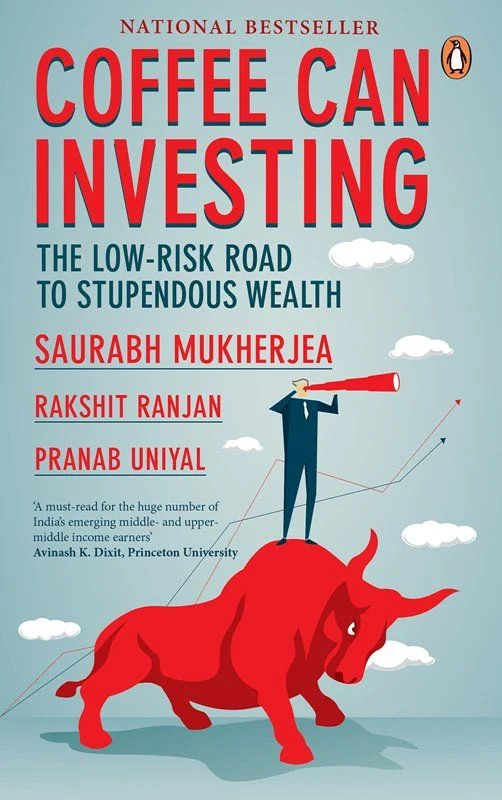
He often explains it simply: revenue growth builds the height of the castle, return on capital builds the moat. With a moat, compounding does the work while investors step away from daily noise.
Artificial Intelligence and the Job Reset
Mukherjea believes artificial intelligence will trigger the biggest shift in India’s white-collar workforce in decades. Referencing long-term research, he estimates that 20 to 25 percent of roles in IT services, customer support and back-office operations could disappear by the early 2030s.
He distinguishes between substitution and complementarity. While certain jobs will vanish, India could emerge as a global hub for data labelling, model training and AI support work. However, he cautions that much of this employment is likely to be gig-based rather than stable, salaried work.
Entrepreneurship Over Salaried Comfort
Mukherjea has consistently argued that long-term salaried stability is fading. Through his Ten Commandments of Indian Entrepreneurship, he stresses risk-taking, patience, relationship-building and continuous learning over credentials and linear career paths.
He believes Indian entrepreneurship must be understood on its own terms, shaped by family-run enterprises, higher capital costs and slower but deeper compounding.
Coaching, Leadership and Unfiltered
In Unfiltered: The CEO and The Coach, Mukherjea documents his five-year coaching journey with Ana Lueneburger. The book presents dual perspectives from both the CEO and coach, without editing each other’s chapters.
He credits coaching with changing how he views leadership, arguing that emotional distance does not create fairness. According to Mukherjea, empathy and trust are not soft skills, but operational necessities for long-term performance.
Influence and Public Role
Mukherjea is a Fellow of the Royal Society of Arts and has served on SEBI’s Asset Management Advisory Committee and its PMS regulation panel. He has been ranked among the top equity strategists by international surveys and remains a regular presence on business news platforms.
He also conducts workshops at Indian business schools, focusing on investing discipline, leadership and long-term thinking.
Family and Personal Life
Mukherjea is married to Sarbani Mukherjea and has two children, Jeet and Malini. Despite his public profile, he keeps his personal life private, often noting that writing while travelling and ignoring online noise helps him stay grounded.
The Throughline
Across investing, writing and public discourse, Mukherjea’s worldview is consistent: ignore noise, respect data and let time work.
In an economy obsessed with speed, his provocation is simple. Wealth, careers and leadership are built by patient gardeners, not fast runners.