
Why Is the ‘Cockroach Janta Party’ Suddenly Everywhere Online?
India’s internet is currently obsessed with one of the strangest viral movements of 2026: the “Cockroach Janta Party” or CJP. What began as satire has now transformed into a massive online conversation around youth frustration, unemployment, meme culture, and political exhaustion. Across X, Instagram, Reddit, and WhatsApp, young users are sharing fake campaign posters, parody manifestos, AI-generated edits, and cockroach-themed political memes. But beneath the humour, many users say the movement reflects something far more serious: The emotional frustration of India’s internet generation. At the centre of this viral movement is Abhijeet Dipke, who is now widely being identified as the creator and public face behind the campaign.
Who Is Abhijeet Dipke?
According to reports, Abhijeet Dipke is a public relations student at Boston University and previously worked in political campaigns and social media spaces associated with the Aam Aadmi Party between 2020 and 2023.
The movement reportedly exploded after Dipke posted a Google Form online inviting people to “join” the Cockroach Janta Party. What initially looked like internet humour escalated extremely quickly, with thousands of registrations and interactions reportedly pouring in within hours.

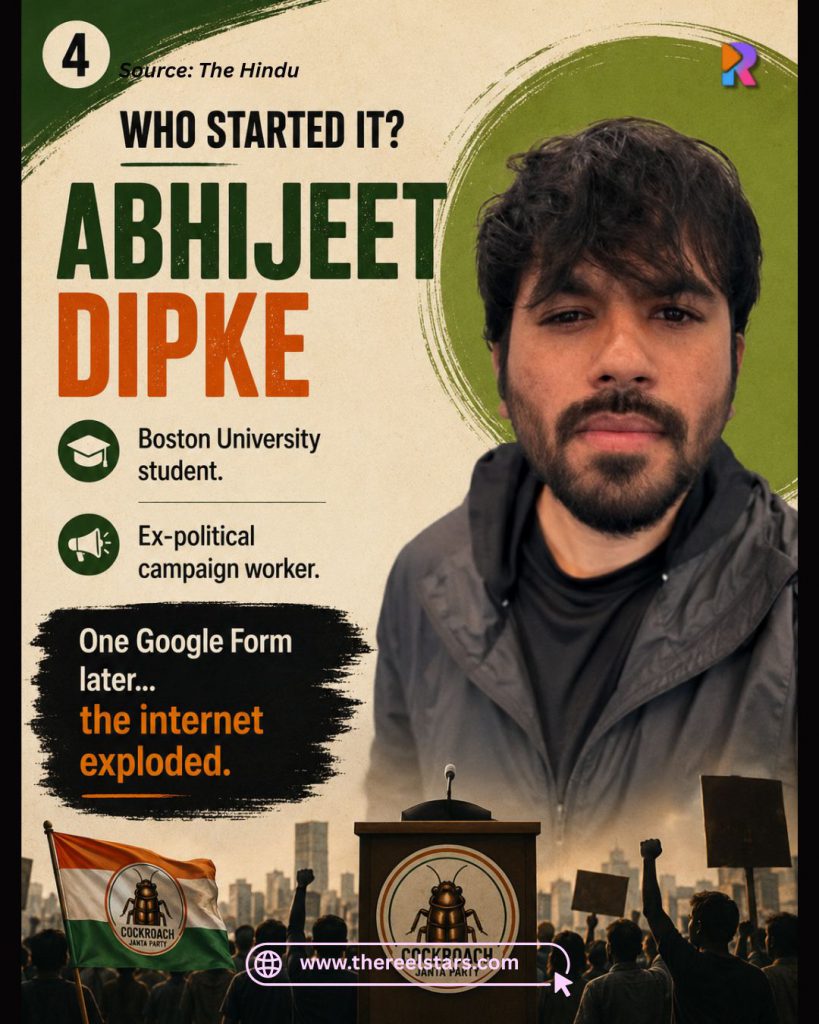
Although there is still no officially confirmed political structure around the movement, online volunteers and meme creators have helped expand it rapidly through: satirical branding, campaign-style visuals, internet humour, and protest messaging. What makes the movement unique is that it feels completely built for internet culture rather than traditional politics.
What Started the Cockroach Janta Party Movement?
The movement reportedly emerged after controversial remarks linked to Chief Justice of India, Surya Kant triggered backlash online. Many internet users believed unemployed youth were indirectly being compared to “cockroaches,” even though later clarification suggested the remarks were aimed at fake degree holders entering professions like law and media.
But by then, the internet had already reacted emotionally.
Instead of rejecting the insult, many young users reclaimed the word entirely and turned it into a meme identity. That reversal became the movement’s biggest viral moment. Almost overnight, “cockroach” stopped being used online as an insult and became: a protest symbol, a meme and a sarcastic representation of ignored citizens struggling within the system. That internet-style reclaiming of mockery is exactly why the movement spread so aggressively across Gen Z platforms.
Also read: Neighbour Nepal’s Social Media Bill: Free Speech or Government Control?
Why Is The Internet Connecting With It So Deeply?
Because the movement reflects frustrations that already existed long before the memes started.
Over the last few years, online conversations around: job scarcity, competitive exam pressure, rising economic anxiety, corruption, and institutional distrust have become increasingly common among young Indians. The Cockroach Janta Party simply packaged those emotions into humour. And that is what internet culture often does best today: It turns frustration into satire before it turns into discussion.
Many users online are now describing the movement as:
“a joke that accidentally became a protest.” That line itself explains why the campaign feels bigger than just meme content.
You might also like: Indian Vlogger Tamil Trekker Shares Strange 4-Day Experience in North Korea: ‘No Locals Spoke’
How Did The Movement Become Bigger Than Just Internet Satire?
The virality intensified after several public figures and politicians acknowledged or interacted with the movement online. Suddenly, what looked like niche meme culture began entering mainstream political conversations. Offline publicity stunts also started appearing, including people dressed as cockroaches cleaning public spaces to symbolically represent “ignored citizens still keeping the system running.”
That imagery worked strongly online because it mixed: humour, embarrassment, social commentary and internet absurdity all together in one visual language.
The movement also feels extremely “Gen Z” in how it communicates. Instead of speeches or serious campaign messaging, it relies almost entirely on irony, memes, exaggeration, and parody aesthetics. That makes it highly shareable and emotionally relatable at the same time.
Is The Cockroach Janta Party A Real Political Party?
Right now, the Cockroach Janta Party appears to exist more as an internet-driven symbolic protest movement rather than a formally established political organisation.
But that is also why people are paying attention to it. Modern internet activism increasingly begins through memes, sarcasm, and viral humour before evolving into larger social conversations. Whether CJP eventually becomes something more structured politically is still unclear. However, what is already obvious is that the movement has captured the mood of a large section of India’s online youth.
Because beyond the jokes and cockroach memes, many people online see it as a reflection of something very real. A generation trying to express frustration in the only language the internet consistently amplifies today, humour.