
Entertainment
Influencer Economy Meets West Bengal Election Season: Poll Push Is Now a Reel Push
As West Bengal elections loom, influencers report ₹20K–80K reel offers from agencies claiming party links; all parties deny formal hiring.

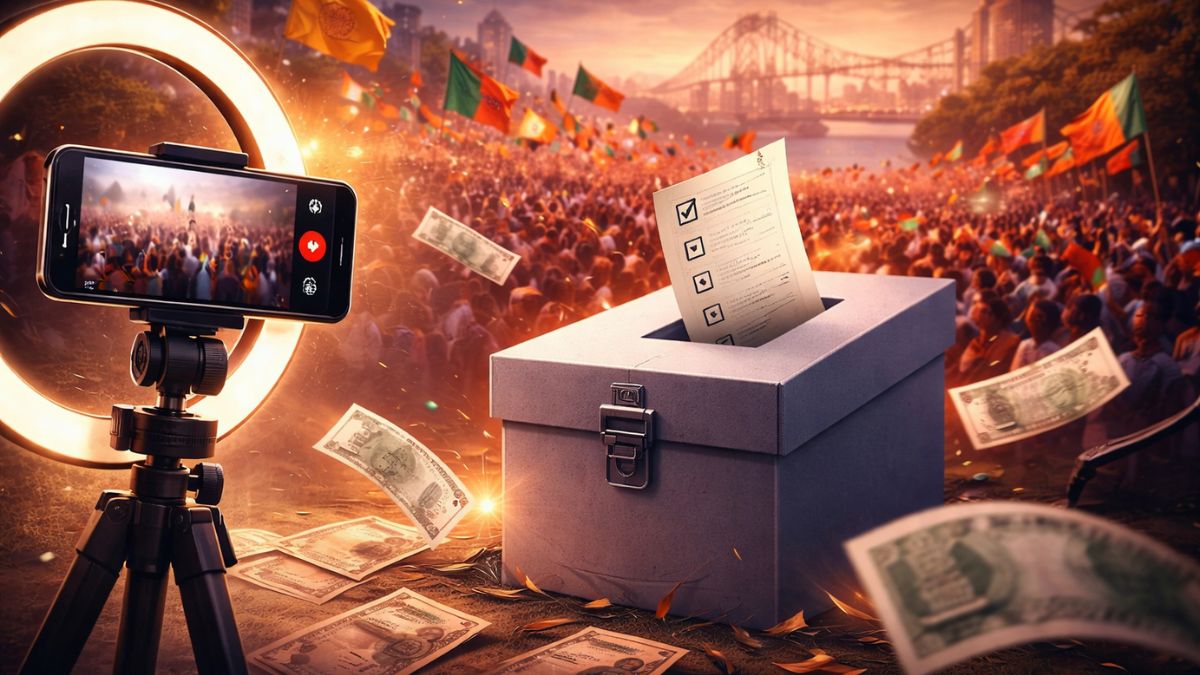
Why Are West Bengal Influencers Suddenly in Demand?
With the West Bengal Assembly election approaching, multiple Kolkata-based influencers say they have received offers ranging from INR 20,000 to INR 80,000 per reel from agencies claiming to represent major political parties. All political parties have denied having paid influencers to push their agenda.
Emails, WhatsApp Messages and Rates
Around a week ago, Kolkata-based content creator Shalini Mukherjee Banerjee, who has over 43,000 combined followers on Instagram and Facebook, claims to have received an email from an agency claiming to represent the BJP. The message, which she later shared via screenshot on Facebook, stated that the agency was scouting paid collaborators for political campaigns.
The eligibility criteria were specific:
• Minimum 20,000 Instagram followers
• Average views of 10,000–15,000
The offer? INR 20,000 per reel.
Speaking to The Telegraph Online, Shalini said she had received several such offers and declined each one.
She was not alone.
Lifestyle vlogger Koninika Dey, a macro-influencer, told The Telegraph Online that she had been approached by both sides. According to her, the remuneration offered was “around INR 80,000 per reel.” She declined, maintaining that she is apolitical.
Also read: 2026 Influencer Trends: The Year the Creator Economy Became Business Infrastructure
How Political Campaign Targeting Works
Influencers in West Bengal describe a tiered outreach model that mirrors corporate brand strategy:
- Nano influencers (under 10K followers) → hyperlocal engagement
- Micro influencers (10K–1 lakh followers) → targeted community messaging
- Macro influencers (1–10 lakh followers) → broader digital reach
- Mega influencers (10 lakh+) → mass influence and cross-platform amplification
Agencies reportedly tailor outreach depending on campaign objective and budget.
Several creators told The Telegraph Online that the content expected would appear “independent,” without direct tagging of political parties. One influencer with nearly 65,000 followers said there is a “definite lack of transparency.”
Ready-Made Reels and Scripted Narratives
Some creators alleged that ready-made reels were provided for posting. Others said agencies from Patna and Noida had contacted them for three-month awareness campaigns focused on government schemes.
One university student, who requested anonymity, admitted to making one political reel before reconsidering. She told The Telegraph Online:
“It is quite evident that some influencers have accepted the offers. Check the content they are putting out now. It is different from what they usually do.”
Another influencer claimed that after declining collaboration offers, she received rape threats.
Koninika Dey told The Telegraph Online:
“I ignored the threats. Voting for a particular party is a matter of choice. I cannot influence people to think one political party is righteous because I think so.”
Congress and the AI Summit Controversy
Parallel to the West Bengal campaign outreach, another allegation has surfaced nationally.
Creators who publicly shared their experiences, Congress media handlers reportedly reached out to young influencers offering INR 10,000–INR 25,000 per reel to post negative videos describing the recent AI Summit as “useless.”
Multiple influencers have alleged a pattern of scripted narratives being offered for compensation. However, these claims remain allegations, and no official confirmation has been issued.
Neutrality remains critical. These claims are attributed to creators who have spoken publicly.
What Do the Political Parties Say?
BJP Response: Saptarshi Chowdhury, convenor of the West Bengal BJP’s social media cell, told The Telegraph Online:
“We have not engaged any outside agency to scout for influencers to work for the party. No such message or email has been sent by the party to anyone.”
Trinamool Congress Response: Debangshu Bhattacharya, head of TMC’s social media and IT cell, confirmed outreach efforts but denied hiring.
“We are not hiring them. We have issued an open call to influencers to fight against the enemies of West Bengal,” he told The Telegraph Online, adding that the party does not have “deep pockets like the BJP.”
Congress Response: Roahan Mitra, West Bengal Congress general secretary and co-chairperson of the social media cell, questioned the feasibility of influencer hiring:
“Where will we get the funds to hire influencers? For the first time in many years, the Congress in West Bengal is contesting in all 294 seats.”
All major parties deny structured paid influencer hiring.
Political Campaigning Meets the Creator Economy
This is not an isolated phenomenon.
India’s creator economy is projected to reach multi-billion-dollar valuations in the coming years (EY & BCG industry reports). Platforms like Instagram and YouTube now act as primary distribution channels, not just for brands, but for political messaging.
Nationally, the BJP has built a reputation for digital communication strength. In November, the party hosted a meet-and-greet event in Kolkata attended by approximately 60 influencers.
Digital-native leaders and creators such as Raj Shamani, Ranveer Allahbadia (BeerBiceps) and Dhruv Rathee have demonstrated how narratives shape public discourse online. While these creators operate in diverse domains, their influence underscores why political strategists view influencer ecosystems as high-impact distribution networks.
Influencers are no longer side players. They are distribution engines.
Why This Matters for Voters
Political influencer marketing blurs the line between independent opinion and paid narrative.
When political messaging appears as organic lifestyle content, transparency becomes essential. Several creators who spoke to The Telegraph Online emphasised that they declined offers because personal belief and business should remain separate. One food vlogger, also a government employee, said:
“They did not even check my background before making the offer. I chose to ignore.”
Are West Bengal influencers being paid for political reels?
Several Kolkata-based influencers claim they received offers ranging from INR 20,000 to INR 80,000 per reel from agencies alleging party links. BJP and TMC deny formal hiring, while Congress questions funding capability.
How much are influencers reportedly being offered?
Reported offers range from ₹20,000 per reel for micro influencers to ₹80,000 per reel for macro influencers.
Did political parties confirm these payments?
No. BJP and TMC denied formal hiring arrangements. Congress leaders stated they lack funds for such campaigns.
What is the ethical concern?
Critics argue that paid political content presented as independent opinion can mislead audiences and reduce transparency in digital political communication.

Influencer Economy Meets West Bengal Election Season: Poll Push Is Now a Reel Push

2026 Influencer Trends: The Year the Creator Economy Became Business Infrastructure

After Malviya Nagar Row, Northeast Creators Answer Hate With Pride and Proof

PM Narendra Modi Crosses 100 Million Instagram Followers

Influencer RJ Princy Parikh Deletes Viral David Miller Reel After R*pe Threats and Body-Shaming

FoodPharmer Launches Whey Protein Isolate (Cocoa): “Buy It Or Don’t. But Consume Only What’s Needed”

Zakir Khan Breaks Silence on Health Rumours

Diya Joukani – Mumbai Designer Turns Street Chaos Into Global Fashion Currency

Influencer Sachin Awasthi Says He Was Detained for 38 Hours in South Korea and China

Vividh, The Kurta Guy Gets Hitched

Food Pharmer’s Cannes Look That Never Walked

Parul Gulati Wears Nish Hair on the Cannes 2025 Red Carpet

Nancy Tyagi’s 700-Hour DIY Gown Turns Heads at Cannes 2025

Navya Nanda’s IIM Ahmedabad Triumph: From Controversy to Campus Joy

Influencer Kareema’s Heartwarming Journey with Suki

Prajakta Koli and Vrishank Khanal’s Wedding

Prajakta Koli’s Haldi and Cocktail Celebrations

Prajakta Koli and Vrishank Khanal’s Pre-Wedding Celebrations

Prajakta Koli x Vrishank Khanal Magical Mehendi

Milind Soman & Ankita’s Maha Kumbh 2025 Experience

TahirFuego, The Shotgun King of Indian Free Fire, Dies at 24

The Reelstars’ Valentine’s Special: Indian Nano Couple Creators Turning Love Into Content

Apoorva Mukhija’s Love Life in the Spotlight: Rumours, Reality Shows & Online Buzz

Is the ‘Vada Pav Girl’ Remarried? Or Is This the Biggest Plot Twist Yet? UPDATED

One Internet Demand: Dhruv Rathee Goes Unfiltered on Learn by KK Create with Kavya

The 50: India’s Biggest Creator-Led Reality Show

Creators Who Turned IND vs PAK Match Moments Into Viral Entertainment

Raj Shamani Joins ICC T20 World Cup 2026, Signalling A Turning Point For India’s Creator Economy

Vaibhav Sooryavanshi: India’s 14-Year-Old Batting Prodigy the World Can’t Stop Watching
