
Lifestyle
Exclusive: Chhote & Aandu: The Couple Behind Billions of Views, Viral Reels and an Unfiltered Creator Life
Who are Chhote & Aandu? Explore Anand and Vaishali’s love story, viral growth, content strategy, money, criticism and life beyond Reels. only on the IRL show.

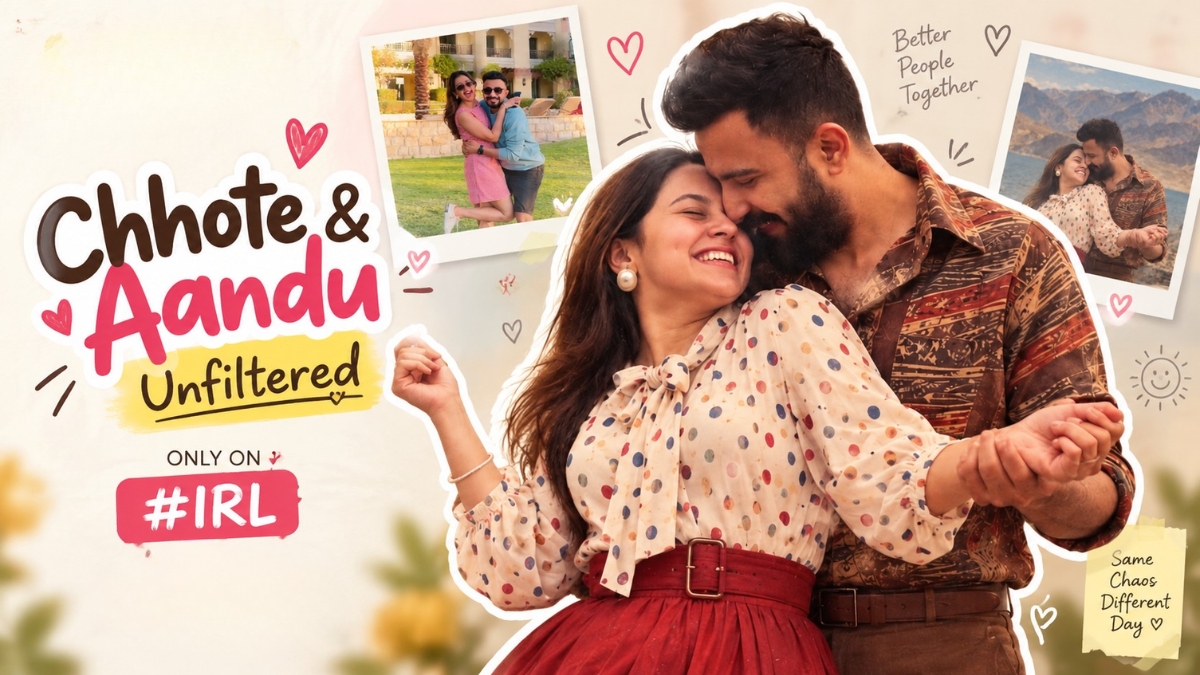
For millions scrolling through Instagram and YouTube, Anand and Vaishali are better known as Chhote & Aandu, the married couple whose playful arguments, childish banter, everyday situations and instantly recognisable chemistry have turned into a massive short-form content business. Their official YouTube channel, listed as Chhote & Aandu / The Abnormal Couple, has crossed roughly 6.2 million subscribers and 9.3 billion views. But the numbers tell only one part of their story. Behind the highly recognisable characters are two people who started with little production knowledge, no dedicated video team, a restaurant business, sceptical parents and videos they now openly admit were far from polished. Their journey is less about having a perfect formula from day one and more about discovering what their audience wanted and then learning how to protect, repeat and evolve that formula without losing the relationship at its centre.
Before Chhote & Aandu, There Was Anand and Vaishali
Long before millions of views, Anand and Vaishali were simply a young couple figuring out their relationship. Their love story itself moved quickly. According to the couple, Anand proposed to Vaishali within just four days of meeting her. The first meeting was not quite as cinematic from Vaishali’s side. She had initially gone out because she wanted to get out of the house after months of restrictions during the COVID period. Anand, however, had apparently taken the occasion much more seriously.
He had prepared himself, getting a haircut, grooming himself and even wearing a jacket carrying “I love you” in multiple languages.
The proposal itself was designed almost like a treasure hunt, with clues leading Vaishali from one place to another before eventually reaching the final message. Within four months, the couple were married. That whirlwind beginning eventually became part of the larger identity that audiences would come to know as Chhote & Aandu.
From a Restaurant to Full-Time Content Creation
Content creation was not initially an obvious career choice for the couple.
Anand had a restaurant, and the decision to leave that business and commit fully to digital content came with considerable uncertainty.
Their families were not immediately convinced. For their parents, the obvious question was simple: How can making videos become a stable career?
Anand recalls being told to stay connected to the restaurant, perhaps as a manager, or at least find a way to recover the money invested in the business.
His response was equally straightforward: if he could eventually make the equivalent of that income from a Reel, why return to the same job?
By then, money had already started coming in through content.
It was nowhere near the scale of their current business, but it was enough to suggest that there could be a future in it.
The turning point for their families came when people began recognising them in public.
Their parents started seeing strangers approach them for photographs and talk about their videos. The reaction changed from uncertainty to pride.
Today, Anand says his father, who runs a gold showroom in Talala, has become one of their biggest supporters, even encouraging customers to subscribe to his son’s YouTube channel.
The Early Videos Were Far From Perfect
The couple’s early content looked nothing like the polished short-form videos they produce today. There was no professional camera team. No dedicated editor. No production crew. At times, there was not even a proper tripod or microphone. They simply placed a phone wherever they could and started recording. Their friends were not particularly impressed. The couple themselves now look back at some of those early videos and admit that the quality, dialogue and presentation were rough.
Yet some of those imperfect experiments became their first viral moments. One of their early viral videos involved food and a theatre setting, while another came from a random trend involving a water bottle. A completely spontaneous video of Vaishali singing and behaving playfully in a bathroom also unexpectedly took off. That unpredictability taught them one of the most important lessons of the creator economy:
Sometimes the content you spend the least time thinking about performs the best.
And sometimes a carefully planned video simply does not move.
How Chhote & Aandu Read the Algorithm
The couple do not claim to have a secret formula for the algorithm. Their approach is much more practical. Keep creating. Keep experimenting. Understand the audience. And, most importantly, understand what the audience has come to expect from you. They have experimented with romance, arguments, comedy, exaggerated couple situations and different trends. But they say they have also learnt that not every format works equally well for their audience.
Their audience expects humour and recognisable couple dynamics. So when a more romantic video performs poorly, they notice it. When something crosses millions of views, they study it. And when a video feels wrong to Anand, he is willing to delete it, even if it is already performing. For them, numbers are not the only measure. The content also has to feel right.
Their Biggest Advantage: Chemistry
Perhaps the biggest reason their content works is that their videos are built around a relationship that already exists.
They do not have to manufacture every interaction from scratch.
Anand says many of the things seen in their Reels are simply exaggerated versions of things that happen between them in real life.
Their arguments, teasing, disagreements over food, household habits and contrasting personalities become raw material.
That also explains why their content can often be created quickly.
The couple says a typical video may take only around half an hour to shoot. If they are planning to post at 9:30 pm, they may shoot around 8:30 pm, edit it and have it ready by posting time.
The real work, however, often happens before the camera is switched on.
The idea has to exist.
And that is where the pressure begins.
From Three Videos a Day to Billions of Views
Their early posting strategy was considerably more aggressive.
At one point, the couple were posting three videos a day around noon, 3:30 pm and 9:30 pm.
Over time, they shifted towards understanding what worked rather than simply increasing output.
One of their biggest lessons came from a video featuring a young girl named Anya.
A concept they had previously tried was recreated with her, bringing a third person into the dynamic.
The result was dramatically stronger.
The couple says that video reached around 112 million views, with millions of likes.
It became an example of how a small change in context can completely alter the performance of a familiar idea.
The Business Behind the Reels
The perception that content creation is simply about viral views is something Anand and Vaishali strongly push back against.
For them, views only become valuable when they translate into sustainable opportunities.
Brands are a major part of that ecosystem.
But the couple does not believe creators should accept every brand instruction without question.
They have become particularly conscious about where a brand integration appears inside a video.
Their argument is simple: if the brand appears too early, viewers may immediately recognise the commercial intent and skip.
Their preference is to establish the normal content first, introduce the brand naturally and then return to the regular story.
That approach, they believe, protects both the creator and the advertiser.
The couple also sees the relationship between brands and creators as a collaboration rather than a hierarchy.
They say they have become more comfortable telling brands when an integration will not work for their audience, even if that means pushing back during negotiations.
The Money Myth Around Content Creation
The couple are candid about one reality: there is money in content creation, but it is not guaranteed. A creator can have a Reel with millions of views and then see the next one receive a fraction of that reach. The challenge is staying creative through that volatility. Brands also return based on results. If a brand invests in a creator and receives poor performance, there is no guarantee that the brand will return.
For Anand and Vaishali, this makes content quality part of the business itself. A viral video may bring attention. Consistent content builds an audience. A strong audience creates commercial opportunities and maintaining that audience becomes the long-term job.
The Darker Side: Fake Pages and Content Theft
As their reach grew, another problem grew alongside it: content theft.
The couple says multiple fake pages have reposted their videos, sometimes almost immediately after the original upload.
In some cases, they say, the reposted content has also accumulated substantial views.
One recurring misconception they encounter is that simply reposting a viral video automatically generates money.
The couple has even contacted some people directly to explain how monetisation actually works.
In one case, they say they eventually threatened to approach the Cyber Cell after repeated reposting continued.
They distinguish this from creators who recreate their concepts themselves.
If another creator takes the basic idea, performs the same dialogue independently and creates their own version, they are far less concerned.
The problem, according to them, is downloading the original video and uploading it unchanged.
For creators whose careers depend heavily on original short-form content, the distinction is significant.
The Relationship Behind the Characters
Perhaps the most interesting part of their story is what happens when the cameras are off. The couple say they do not fight as dramatically as their Reels might suggest. Their approach to disagreements is relatively simple: let the other person speak. They also try not to bring third parties into their arguments. According to them, many relationship disputes begin when partners start fighting over what a parent, sibling or friend said or did. Their solution is to keep the conversation between the two people involved. For Vaishali, one of Anand’s biggest green flags is his willingness to listen. For Anand, Vaishali’s playful, childlike personality is one of the things he loves most about her. That dynamic is also what makes their content work. The characters are exaggerated, but the chemistry underneath them is real.
Family, Marriage and the Question of Children
Five years into marriage, the couple also face questions about parenthood. They say family and people around them have asked about having children, but they see parenthood as a responsibility rather than a milestone to be completed simply because others expect it. Their town lifestyle remains a major consideration. They travel, work irregular hours and they wake up late. Their schedules are unpredictable. And they have recently experienced another form of responsibility through their dog, Pookie. The couple describes treating Pookie almost like a child, including planning around who can look after him when they travel.
For Vaishali especially, responsibility is something she takes seriously.
Her reasoning around parenthood is therefore practical: if they eventually decide to have a child, they want to be in a position where they can actually take care of that responsibility themselves.
They Are Not Trying to Sound Like Anyone Else
One of the clearest insights into Chhote & Aandu’s creative philosophy comes from their approach to language. The couple says they prefer speaking the way they naturally speak. If a scripted line contains a word they would never use in real life, they may change it. If a brand asks them to deliver something word-for-word but it does not sound natural, they believe the audience will notice. For them, Hindi is not simply the language of their content. It is part of their identity. Anand’s Gujarati influence and accent are also part of that authenticity rather than something they try to hide. Their philosophy is straightforward: If they would not say it in real life, they should probably not say it in a Reel either.
Their Content Is Often Created in Real Time
This becomes particularly obvious when the couple is asked to improvise.
During a live challenge, they can take a simple situation- Vaishali wants tea, Anand wants coffee and turn it into a couple argument within seconds. The dialogue is not perfectly scripted. tThey interrupt each other, they change lines and they react to what the other person says. And that is precisely what makes the exchange usable as content. Their creative process is therefore not just about writing. It is about knowing each other’s reactions well enough to improvise.











Exclusive: Chhote & Aandu: The Couple Behind Billions of Views, Viral Reels and an Unfiltered Creator Life

Vir Das Gets Third International Emmy Nomination For ‘Fool Volume’

Why Is MrBeast Back in India? Is His India Connect Getting Bigger in 2026?

Darshan Magdum To Finally Arrive In US As Boy Throb Announces Free Darshan Day Event

Mirabai Chanu Wins Silver At Asian Games 2026, Ends India’s 28-Year Wait For Weightlifting Medal

MS Dhoni Becomes SpeakX Brand Ambassador For English Learning Campaign

Adam Mosseri Reveals Instagram Trial Reels Rule That Could Limit Your Reach

Ranveer Allahbadia Takes Gen Z Inside India’s Space-Tech Boom With Skyroot Visit

7 Indian States Using Creators To Promote Tourism, Culture And Government Schemes

Shru Gaming: The Mom Gamer Proving Gaming And Motherhood Can Coexist

Food Pharmer’s Cannes Look That Never Walked

Parul Gulati Wears Nish Hair on the Cannes 2025 Red Carpet

Nancy Tyagi’s 700-Hour DIY Gown Turns Heads at Cannes 2025

Navya Nanda’s IIM Ahmedabad Triumph: From Controversy to Campus Joy

Influencer Kareema’s Heartwarming Journey with Suki

Prajakta Koli and Vrishank Khanal’s Wedding

Prajakta Koli’s Haldi and Cocktail Celebrations

Prajakta Koli and Vrishank Khanal’s Pre-Wedding Celebrations

Prajakta Koli x Vrishank Khanal Magical Mehendi

Milind Soman & Ankita’s Maha Kumbh 2025 Experience

Meta One Launches With Paid AI, Creator Tools And New Features Across Instagram, Facebook And WhatsApp

AI Content Creator Platform Creedom Raises ₹4.1 Crore in Seed Funding

Could Bilibili Be the Next Creator Opportunity for Indians?

ScoutOP Reveals ₹30 Lakh Monthly Income

R Udhay Is Helping Creators Level Up Their Content With Editing, AI & Instagram Tips

Snoop Dogg Has the Job We All Secretly Want: ₹10 Lakh A Month to Eat Ice Cream

Internet Famous Golden Retriever Tucker Budzyn Diagnosed With Lymphoma

Delhi vs Mumbai Review: A Predictable Love Story That Somehow Works

Who Was Manjeet Kaur? What We Know About the Punjabi Influencer’s Death
