
Finance
From a Piggy Bank to a Rs 14 Lakh Portfolio: Meet Sinchana Santosh, the 15-Year-Old Making Financial Literacy Her Mission
At 15, Bengaluru’s Sinchana Santosh manages investments under parental supervision, creates educational games and aims to teach one million students about money.

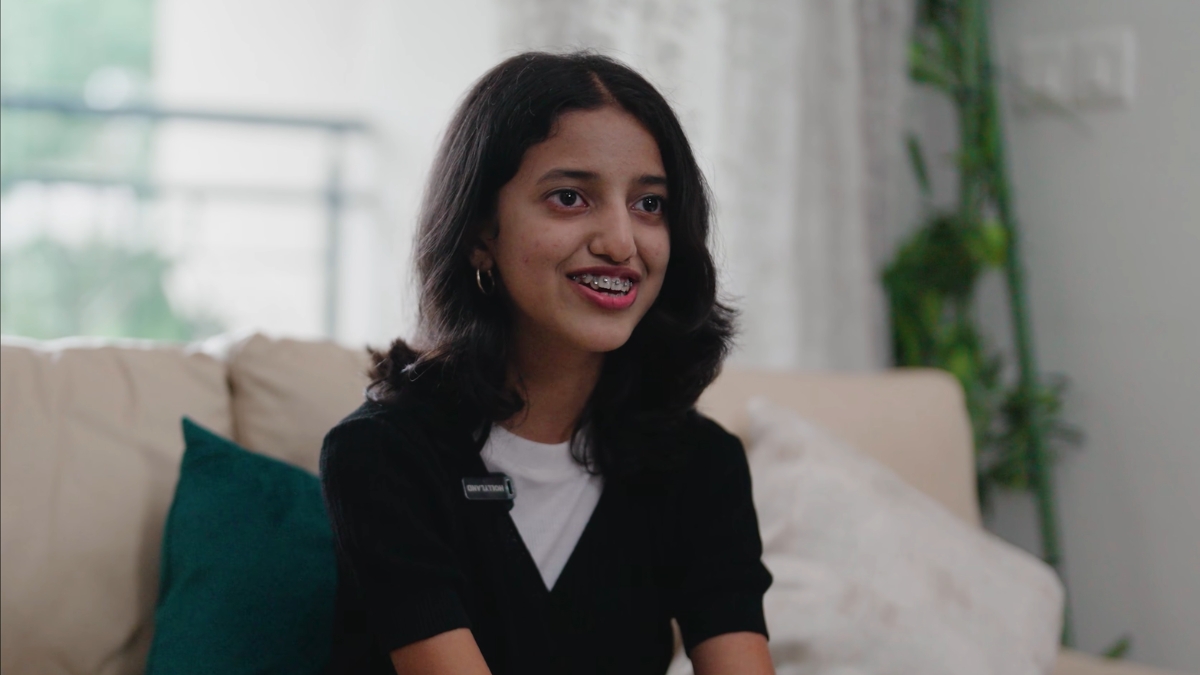
At an age when many students are still getting acquainted with the basics of personal finance, Sinchana Santosh is already putting her lessons into practice. The 15-year-old Class X student at Swargarani School in RR Nagar, Bengaluru, manages an investment portfolio valued at approximately Rs 13.9 lakh, with her parents’ supervision. But her story is about more than the size of her portfolio. It is also about the habits, questions and experiences that shaped her relationship with money and her ambition to make financial literacy more accessible to other students. In a recent interview, Sinchana spoke about her early experiences with saving, learning about investments through YouTube and certifications, developing a history-based card game, and the family values that encouraged her to become financially independent. She also shared a longer-term goal: to help teach financial literacy to one million students.
A telescope, a piggy bank and the beginning of a money journey
Sinchana’s interest in money began with small, familiar experiences. She saved in a piggy bank and, by the time she was around 12, had accumulated approximately Rs 10,000. She remembers feeling proud as the amount grew, and the experience taught her that consistent saving could help her plan for something she wanted.
One childhood wish gave her an early lesson in resourcefulness. Sinchana wanted a telescope, but it was too expensive for her father to buy outright. Instead, he suggested that she raise part of the money herself. She approached relatives and offered them the chance to use the telescope whenever they visited her home. The effort brought in Rs 10,000, while her parents contributed the remaining Rs 2,000.
The telescope was purchased, and Sinchana remembers that experience as the beginning of her “money journey”. It was an early example of how her family encouraged her to take part in financial decisions rather than simply receive the things she wanted.
Learning before investing real money
Her parents encouraged her to build a foundation in financial concepts before she began managing investments. Sinchana pursued two NISM certifications and one SEBI certification, preparing alongside her schoolwork.
She began studying for an NISM examination during the final week of Class IX. Balancing school assignments and exam preparation was demanding, so she used weekends and holidays to learn. YouTube also became an important resource. She mentioned learning from Ankur Warikoo, Power of Money, Wind Wealth and Sonia Shenoy.
Her certification journey included a setback. Sinchana recalled scoring 59 when 60 per cent was required to pass her first examination. She was disappointed, but she applied again and prepared for another attempt. The second round came with its own pressures, including school projects, assignments and a Scouts and Guides camp. She also described the mutual fund examination as particularly challenging, with limited preparation time.
For Sinchana, the examinations were not simply credentials. They were a way to test whether she had understood the concepts well enough to begin applying them. Her father also viewed the certifications as a structured way to assess her readiness before she handled real money.
Why she believes personal finance belongs in schools
Sinchana believes many children are not introduced to personal finance early enough. She said that some of her friends were unfamiliar with investment concepts and often asked her what particular terms meant.
That experience led her to think about what schools could do differently. She suggested that even an hour of personal finance education each week could help students learn how to manage money. Understanding spending, saving and investing, she argued, could make everyday life easier.
Her own learning has involved both formal study and accessible online resources. She also emphasised the importance of sharing what she learns, rather than treating financial knowledge as something to keep to herself.
A portfolio built around a seven-year goal
Sinchana began investing more seriously in April of the interview year, after her parents withdrew money from insurance policies that they felt were not delivering satisfactory returns. They handed the money to her to manage, with their supervision.
At the time of the interview, she put the portfolio’s value at approximately Rs 13.9 lakh, or around Rs 14 lakh. She described it as diversified across asset classes and markets:
- 63 per cent in equity
- 37 per cent in mutual funds
- 71 per cent in Indian markets
- 29 per cent in international markets, including the US, Asian markets and Taiwan
She said she reads newspapers, usually on weekends, and pays attention to information that could affect the stocks in her portfolio. Decisions about whether to buy, sell or hold are discussed with her parents.
Her investment horizon is seven years. The goal is to fund her master’s education, although she has not yet decided which subject she will pursue. Sinchana hopes the portfolio could grow to around Rs 45 lakh over that period. This is her stated aspiration, rather than a guaranteed outcome.
The GDP framework she uses to select funds
Sinchana has devised a simple framework called GDP – Growth, Direct and Passive – to help her think about mutual fund selection.
Growth refers to her preference for growth-oriented options because she does not need the money immediately and is investing towards a longer-term goal. Direct refers to choosing direct plans to reduce intermediary charges. Passive refers to funds that replicate benchmark indices.
She explained that the acronym helps her remember the criteria she considers when selecting funds. Her approach, as she described it, combines a long-term objective with attention to costs and the way a fund is managed.
Although she manages the portfolio herself, Sinchana stressed that she does so under her parents’ supervision. Their involvement is part of the structure through which she is learning to make financial decisions.
How her parents encouraged independence
Sinchana’s parents, Keerti Raikar, who runs a silver jewellery retail business, and Santosh Raikar, a director at SP Jain Institute of Management Research, described independence as an important family value.
Her father spoke about growing up in a family where children were encouraged to make decisions, travel and develop confidence in handling both financial and emotional matters. He wanted to pass that sense of independence on to his daughter, so she would feel able to make her own financial choices in the future.
Her early exposure to money was practical. Her father recalled taking her to an ATM when she was around four or five and allowing her to handle parts of the transaction using his card under his supervision. The aim was to make financial processes familiar and help her become more confident.
The family also drew inspiration from Warren Buffett’s early start in investing. Sinchana’s father referred to Buffett beginning to invest as a teenager and the value of having more time for compounding. The family wanted to give Sinchana an early opportunity to learn, but in a planned way, with guidance and room to learn from mistakes.
Investing is also about managing emotions.
For Sinchana and her parents, financial knowledge is only one part of investing. They also discussed the psychological side of managing money, particularly the need to remain calm when markets are volatile.
Her father said that managing emotions matters alongside understanding investment techniques. They spoke about resisting the fear of missing out, or FOMO, and the impulse to spend under a “you only live once” mindset. The family watched personal finance videos, including content from Dave Ramsey, as part of their learning.
Their approach places emphasis on making considered decisions, rather than reacting immediately to market movements or social pressure. For Sinchana, the experience of managing a portfolio with parental supervision is also an opportunity to develop emotional discipline.
Turning a love of history into a card game
Finance is not Sinchana’s only interest. History has long been a favourite subject, and she has been particularly curious about temple architecture and historical figures such as Shivaji Maharaj and Krishnadeva Raya.
The idea for a history-based card game came while she was playing Pokémon cards with a friend after guitar class. She wondered why she could remember Pokémon characters so easily but found historical figures harder to recall. That question led her to consider whether a game could make history more engaging and help students remember facts through repeated play.
She developed ITIHASA – The Royal Game, based on historical characters from the NCERT syllabus for Classes VII to X. The game includes 50 characters, along with rules and a manual explaining how to play. Sinchana described the approach as active recall: players repeatedly see and discuss the information on the cards, helping them practise remembering it.
She explained that the cards include general facts about historical figures, such as the period in which Ashoka lived and the empire he belonged to. Repeatedly encountering those details through gameplay, she said, can help students recall them more readily than relying on a single study session before an examination.
According to the account of her work, she has donated 170 sets of the history game to 36 government high schools in Bengaluru and trained school principals to use it.
From history games to financial education
Sinchana is now working on a strategy-based financial card game. The planned subject areas include budgeting, banking, interest, inflation, investing, risk, insurance, credit, debt and fraud awareness.
The project brings together two of her interests: making learning engaging and helping young people understand practical concepts. Rather than approaching financial literacy only through explanations, she wants to use a format that encourages students to participate, practise and remember.
Her larger ambition is to reach one million students with financial education. She is already teaching friends about financial topics and other subjects that interest her, and she hopes to extend that effort to a much wider audience.
A lesson in social responsibility during COVID-19
Sinchana’s interest in using what she learns to help others also has roots in her family’s experience during the COVID-19 pandemic.
When the family was infected, BBMP Asha workers visited homes to deliver medicines and support people affected by the virus. Sinchana wondered why more was not being done to protect the workers, who were entering homes where people had COVID-19. She asked whether they could do something to help.
With her parents’ support, she made a video appealing for assistance and helped raise approximately Rs 45,000. The family worked with ABMRCI hospital to procure and distribute PPE kits, masks and gloves for ASHA workers.
Her father described the experience as an example of moving from concern to practical action. He also used an analogy to explain why experience matters: watching hours of swimming videos cannot teach someone to swim without getting into the water. In the same way, the family believed that Sinchana needed an opportunity to apply what she had learned, with appropriate guardrails and support.
“Don’t be afraid to try to experiment”
Sinchana’s advice to other young people is straightforward: “Don’t be afraid to try to experiment.”
She has noticed that some of her friends hesitate to try new things because they assume they will not be good at them. Her message is that people cannot know what they are capable of without giving themselves the opportunity to try.
That outlook runs through the different parts of her story from raising money for a telescope and studying for certifications to creating educational games and learning to manage investments. It is also reflected in her belief that knowledge should be shared.
At 15, Sinchana is still deciding what she wants to study for her master’s degree. Her portfolio, meanwhile, has a stated seven-year horizon, and her financial literacy initiative has a much wider ambition. She hopes to reach one million students, helping them build familiarity with money and the decisions that shape their financial lives.
Her journey is not a universal template for young investors, and the value of any portfolio can change with market conditions. What her account illustrates is the role that early exposure, structured learning, parental guidance and practical experience can play in developing a young person’s understanding of money alongside a desire to pass that knowledge on.

From a Piggy Bank to a Rs 14 Lakh Portfolio: Meet Sinchana Santosh, the 15-Year-Old Making Financial Literacy Her Mission

Creators Kshitiz And Shivangi Welcome Their Baby Girl

AMD Joins $1 Trillion Club As Shares Surge 180% In 2026: How AI, Gaming And Tech Are Driving The Chipmaker

MrBeast Unveils Nearly $10 Million Ghana Village To Help Children Affected By Child Labour

Meta Launches Edits Film Festival to Spotlight India’s Emerging Creators

AnyMind Group Launches AnyCreator Stream In India To Help Creators Grow And Monetise Live Streaming Audiences

Samay Raina, Medha Shankr React to December Wedding Rumours With Hilarious Replies

Meta One Launches With Paid AI, Creator Tools And New Features Across Instagram, Facebook And WhatsApp

Khushi Jain And Rohan Sharma Share What They Wish They Knew Before Becoming Creators

Siddhesh Lokare Takes His Social-Impact Stories To The Stage With Musical Show ‘APAAR’

Food Pharmer’s Cannes Look That Never Walked

Parul Gulati Wears Nish Hair on the Cannes 2025 Red Carpet

Nancy Tyagi’s 700-Hour DIY Gown Turns Heads at Cannes 2025

Navya Nanda’s IIM Ahmedabad Triumph: From Controversy to Campus Joy

Influencer Kareema’s Heartwarming Journey with Suki

Prajakta Koli and Vrishank Khanal’s Wedding

Prajakta Koli’s Haldi and Cocktail Celebrations

Prajakta Koli and Vrishank Khanal’s Pre-Wedding Celebrations

Prajakta Koli x Vrishank Khanal Magical Mehendi

Milind Soman & Ankita’s Maha Kumbh 2025 Experience
Meta One Launches With Paid AI, Creator Tools And New Features Across Instagram, Facebook And WhatsApp

Could Bilibili Be the Next Creator Opportunity for Indians?

A YouTuber Begged For A Day And Earned ₹4000. Here’s What Happened

China’s Bilibili Goes Global, Taking Aim at YouTube and Gen Z

AI Content Creator Platform Creedom Raises ₹4.1 Crore in Seed Funding

R Udhay Is Helping Creators Level Up Their Content With Editing, AI & Instagram Tips

Poonam Singh Is Turning Everyday Gen-Z Chaos Into Relatable Content

ScoutOP Reveals ₹30 Lakh Monthly Income

Internet Famous Golden Retriever Tucker Budzyn Diagnosed With Lymphoma
