
Sports
Jonathan Gaming, Shreeman Legend And TechnoGamerz Take Indian Gaming To Silverstone For ‘Max vs 100’
Three Indian gaming creators joined Max Verstappen and 100 challengers in Red Bull’s unusual karting showdown at Silverstone.

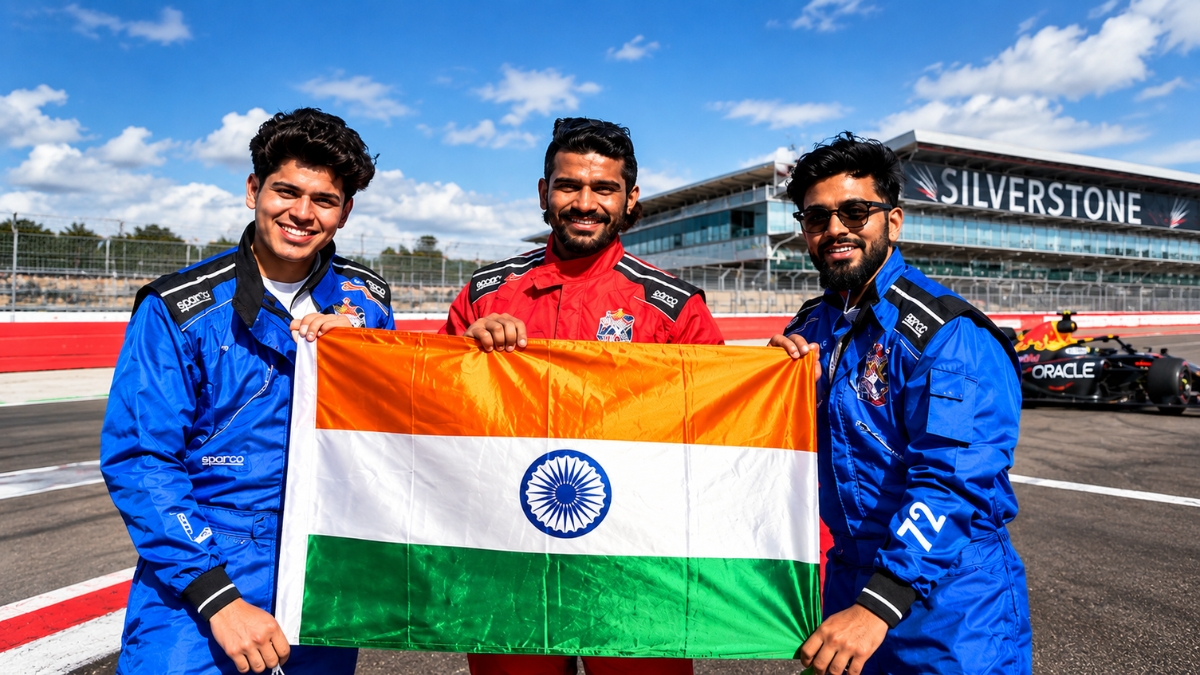
India’s gaming creator community found itself on one of motorsport’s most recognisable stages this week. Jonathan Gaming, Shreeman Legend and TechnoGamerz joined 100 challengers from across sport, gaming, entertainment and social media for Red Bull’s ‘Max vs 100’ karting event at Silverstone on September 16. The event placed four-time Formula 1 World Champion Max Verstappen against a field that included professional athletes, streamers, creators and racing enthusiasts. For India’s creator economy, the event was notable for another reason. The three participants came from different corners of the gaming ecosystem, bringing one of the country’s largest digital entertainment communities into a global motorsport spectacle.
Three Indian Gaming Names On A Global Grid
The Indian contingent included Ujjwal Chaurasia, better known as TechnoGamerz, professional esports player Jonathan Amaral, known as Jonathan Gaming, and streamer Shreeman Legend, whose real name is Siddhant Praveen Joshi.
Red Bull’s published driver list confirms all three as participants in the event.
Their inclusion also reflects the changing relationship between gaming and mainstream sports.
TechnoGamerz has built one of India’s biggest gaming audiences, while Jonathan Gaming is strongly associated with BGMI esports and streaming. Shreeman Legend brings another creator-led gaming identity to the line-up.
Together, they represented a category that increasingly overlaps with sports, entertainment and youth culture.
What Was ‘Max vs 100’?
The concept was deliberately unusual.
Instead of giving Verstappen a conventional karting race, Red Bull put 100 challengers ahead of him.
Verstappen started from 101st place and had 30 laps to overtake every driver ahead of him. The other 100 participants used identical karts, with their starting positions determined through qualifying laps.
The event also introduced a shortcut mechanic known as the Fast Lap. The 100 challengers could use the shortcut during the first half of the race, while Verstappen could use his later in the event.
Once Verstappen overtook a challenger, that driver was eliminated from the race.
The result was less like a traditional motorsport competition and more like a live-action video game.
Verstappen Had One Job
The challenge was built around Verstappen’s childhood relationship with karting.
The Dutch driver began karting at four and competed in championships from the age of seven before progressing through junior racing and eventually reaching Formula 1.
This time, however, there were 100 obstacles between him and the finish.
And Verstappen completed the challenge far quicker than the format allowed.
Reports from the event said he overtook the entire field in 14 laps, taking roughly 35 minutes, despite having up to 30 laps to complete the task.
That result meant the 100 challengers, including the Indian creators, were ultimately unable to keep the four-time champion behind them.
But that was arguably not the only point of the event.
Why Put Gaming Creators On A Karting Grid?
‘Max vs 100’ was designed as a hybrid entertainment property rather than a conventional motorsport race.
The field brought together people who would rarely appear on the same sporting grid.
Olympic-level athletes, extreme-sports personalities, professional competitors, YouTubers, streamers, celebrities and fans all occupied the same starting field. Red Bull described the event as a combination of sport, entertainment and innovation.
That format explains the inclusion of gaming creators.
For brands such as Red Bull, gaming audiences are no longer separate from sports audiences. Both communities are heavily invested in competition, performance, personality and entertainment.
Putting creators such as TechnoGamerz and Jonathan Gaming into a physical racing environment effectively takes the creator experience outside the screen.
From Virtual Competition To Real-World Racing
There is also an interesting irony in seeing gaming creators compete in actual motorsport.
Their careers have largely been built around virtual worlds.
Gaming rewards reactions, strategy, timing and decision-making. Karting requires many of the same instincts, but adds physical factors such as braking, grip, racing lines and spatial awareness.
The event did not turn the creators into professional racing drivers.
Instead, it created a format where their existing competitive identities could enter an entirely different arena.
That distinction matters because the creator economy is increasingly expanding beyond traditional social content.
Creators now appear in sporting events, reality shows, brand experiences, entertainment productions and live events. Their value is no longer limited to the number of videos they upload.
Silverstone Adds Another Layer
The location was equally important.
Silverstone is one of the most recognisable venues in Formula 1, making the event more than just another celebrity karting race.
For the occasion, a purpose-built circuit was created so that 101 karts could compete simultaneously. Red Bull and Disney described it as one of the biggest kart races of its kind, combining a racing format with game-inspired graphics, live data and cinematic production.
That production approach was significant because ‘Max vs 100’ was designed for a global digital audience rather than only the people physically watching from the venue.
The event was presented by British comedian Mo Gilligan, with the broadcast incorporating live race information and entertainment-focused elements.
A Bigger Moment For Indian Gaming Creators
For Indian gaming creators, the significance goes beyond one race.
TechnoGamerz, Jonathan Gaming and Shreeman Legend were not invited simply as spectators. They were part of the competitive field alongside internationally recognised athletes and creators.
That places Indian gaming talent inside a much broader global entertainment ecosystem.
TechnoGamerz, for instance, has built a YouTube audience of more than 50 million subscribers, while Jonathan Gaming has established himself as a major Indian esports creator.
Their presence at Silverstone therefore also demonstrates how far gaming creators have travelled from the traditional image of someone simply streaming from a bedroom.
They can now become part of global sports properties.
The Creator Economy Meets Motorsport
‘Max vs 100’ may ultimately be remembered for Verstappen’s rapid run through the field.
But its more interesting legacy could be the format itself.
A Formula 1 champion.
A 101-kart grid.
Gaming creators.
Olympic athletes.
Streamers.
Social media personalities.
And fans.
All of them were brought together inside one piece of entertainment designed specifically for the digital era.
For Indian audiences, Jonathan Gaming, Shreeman Legend and TechnoGamerz gave that experiment a distinctly Indian connection.
The race may have belonged to Verstappen, but the bigger story was about who gets to be part of the modern sports audience and increasingly, who gets to become part of the sporting spectacle itself.

Jonathan Gaming, Shreeman Legend And TechnoGamerz Take Indian Gaming To Silverstone For ‘Max vs 100’

Architha: How a Telugu Creator Turned Relatable Gen Z Rants Into Her Own Digital Niche

How Zohran Mamdani Is Using Influencers To Reach New Yorkers

‘India Has a R*pe Problem’: Meet Anaheez Patel, the Creator Speaking Beyond Her Fitness Niche

Niharika Tiwari Confirms Breakup With Sorab Bedi, Says Their Relationship Was “Real”

Kartika Jalani: From Chartered Accountant To India’s Got Latent

Who Is Amin Jaz? The DJ and Podcaster at the Centre of Apoorva Mukhija Dating Buzz

Ashneer Grover Calls New UPI Merchant Charge a ‘Tax’: What the New Rule Actually Changes

Budding Creator Krisha Shah Sparks Debate After Sharing Her View On Abortion And Down Syndrome

Major Rishabh Singh Sambyal Goes Viral as 1,000+ Fans Subscribe to His Instagram Content

Food Pharmer’s Cannes Look That Never Walked

Parul Gulati Wears Nish Hair on the Cannes 2025 Red Carpet

Nancy Tyagi’s 700-Hour DIY Gown Turns Heads at Cannes 2025

Navya Nanda’s IIM Ahmedabad Triumph: From Controversy to Campus Joy

Influencer Kareema’s Heartwarming Journey with Suki

Prajakta Koli and Vrishank Khanal’s Wedding

Prajakta Koli’s Haldi and Cocktail Celebrations

Prajakta Koli and Vrishank Khanal’s Pre-Wedding Celebrations

Prajakta Koli x Vrishank Khanal Magical Mehendi

Milind Soman & Ankita’s Maha Kumbh 2025 Experience

Could Bilibili Be the Next Creator Opportunity for Indians?

Rohit Sukheja and Kanupriya Gupta Hit 5 Billion YouTube Views

China’s Bilibili Goes Global, Taking Aim at YouTube and Gen Z

A YouTuber Begged For A Day And Earned ₹4000. Here’s What Happened

R Udhay Is Helping Creators Level Up Their Content With Editing, AI & Instagram Tips

Rebel Kid Taking Her Journey From Social Media To Columbia University

AI Content Creator Platform Creedom Raises ₹4.1 Crore in Seed Funding

Bihar Creators Can Earn Up to ₹1 Lakh Per Video Under New Social Media Rules

Poonam Singh Is Turning Everyday Gen-Z Chaos Into Relatable Content
