
Lifestyle
Creator and Marketer Janhavi Vedpathak: Breaking Down Why Brands Do What They Do
From investment banking to brand marketing, Janhavi Vedpathak turns ads, pop culture and consumer behaviour into content

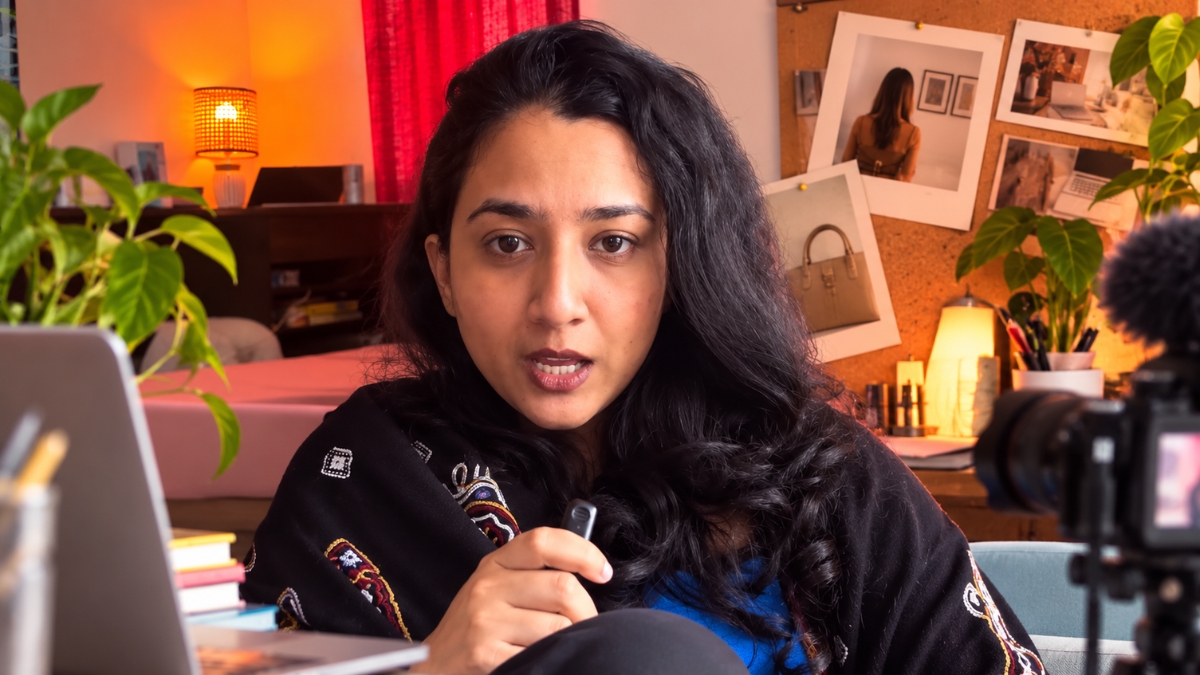
Why are new-age brands spending money on shows like Kaun Banega Crorepati and Bigg Boss when Instagram offers cheaper advertising and sharper targeting? Why do brands put phrases such as “No Artificial Colours and Flavours” on products when consumers may not have even been thinking about it? And why would a brand use a town, its culture or even its identity as the centre of an advertisement? These are the kinds of questions Janhavi Vedpathak, who creates content as @girl_in_marketingg, has been turning into short, easy-to-understand marketing breakdowns. Her content sits at the intersection of marketing, pop culture and consumer psychology. Instead of explaining marketing through textbooks or corporate jargon, she takes campaigns, advertisements, celebrities and everyday consumer behaviour and asks a simple question: why did the brand do that?
Who is Janhavi Vedpathak?
Vedpathak is a marketing professional based in Bengaluru and describes her online identity simply as “Girl In Marketing.”
Her Instagram account, @girl_in_marketingg, has built a community around marketing and advertising explainers, while her LinkedIn profile has also become an extension of the same content.
She has a background in finance and business. She studied Business Administration with a focus on International Business, Accounts and Finance at Symbiosis Centre for Management Studies, Pune, and also studied at IÉSEG School of Management in France.
Her professional journey has moved through finance, investment banking and marketing before she moved deeper into brand-building.
Her LinkedIn profile currently identifies her with CoinSwitch, while third-party professional listings have also carried earlier employment information. Her public content, however, consistently centres on marketing and consumer behaviour.
That combination of finance, business and marketing experience is visible in the way she approaches content.
She is not simply asking whether an advertisement is good or bad.
She is asking what the brand is trying to make the consumer feel, remember or believe.
Her latest viral conversation: Why are new-age brands returning to TV?
One of Vedpathak’s recent reels looks at a marketing shift that can seem counterintuitive.
Digital-first brands have spent years moving advertising budgets towards Instagram, YouTube and other digital platforms because these channels offer targeting, measurable performance and relatively easy user acquisition.
So why are some of these brands appearing on television’s oldest and most familiar formats?
Her reel points to examples such as Snapdeal around Bigg Boss, Stable Money around KBC and CoinSwitch around Anil Kapoor’s India Ke Top 1%.
Her argument is straightforward: for certain categories, particularly financial products, reach is not the only objective. Trust and familiarity matter too.
An Instagram advertisement saying “invest in fixed deposits” can appear between completely unrelated posts.
But when a financial brand repeatedly appears within a familiar television programme, alongside a recognisable host, the association can feel different.
Vedpathak describes the formula as:
Young app + legacy TV = trust and credibility.
She then breaks down why reality shows can be particularly useful.
A programme such as KBC runs repeatedly over a period of time. A viewer can see the same brand integration again and again.
The first time, the brand may simply register.
Then it appears again.
And again.
Eventually, the brand becomes associated with the programme itself.
That is the central idea behind her reel: television may be expensive and less precisely targeted than social media, but repeated exposure within familiar programming can help newer brands build familiarity and credibility.
The reel turns what could have been a complicated media-planning discussion into something viewers can understand in just over a minute.
She breaks down the psychology behind everyday advertising.
This is not the first time Vedpathak has used familiar brands to explain consumer psychology.
In one of her marketing breakdowns, she looks at Kurkure, Uncle Chipps and Doritos and a phrase that appears across their packaging: “No Artificial Colours and Flavours.”
Her point is that brands can answer a question before consumers consciously ask it.
The consumer may not have walked into a shop wondering whether the snack contains artificial colours.
But once the packaging highlights the absence of them, the question enters the consumer’s mind.
Vedpathak calls this reassurance marketing.
She breaks it into three steps:
- Identify a subconscious question.
- Address it before the consumer asks.
- Use the answer to create reassurance and trust.
It is typical of her content style: take something people see every day and explain the strategy hiding behind it.
When advertising uses a place as a prop
Another recurring theme in her content is how brands use culture and geography in advertising.
She has discussed campaigns involving Flipkart’s Kodinhi campaign in Kerala and Pond’s campaign in Phalodi, Rajasthan.
Kodinhi is known for its large population of twins, making it an obvious creative fit for a “buy one, get one” message.
Phalodi, meanwhile, is known for its extreme heat, which made it a natural setting for a sunscreen campaign.
But Vedpathak’s content focuses on what happens when the creative idea does not sufficiently represent the place being used.
In the case of the Kodinhi campaign, she pointed to criticism around the dialect and Malayalam writing.
With the Phalodi campaign, she raised questions about whether the community itself received anything beyond the campaign experience and product samples.
Her larger marketing question is whether a location is being treated as part of the story or simply as a visual device.
Again, she uses advertising to open a larger conversation about representation, authenticity and consumer perception.
Bollywood becomes marketing case study material.
Celebrity culture is another major part of Vedpathak’s content.
She has analysed the online reaction around Alia Bhatt, looking at how a celebrity’s perceived success can influence how audiences respond to criticism.
Her argument is that a successful film career can create a kind of social protection around a celebrity. When that perception of success changes, existing criticism can become more visible.
She has also examined celebrity endorsements and brand associations.
One example is Shah Rukh Khan’s association with Vodafone Idea, after his previous endorsements for other telecom companies.
Rather than simply reporting that a celebrity has signed another brand deal, her content asks why a telecom company would continue to use a face that audiences have already seen across competing brands.
That is the recurring format of @girl_in_marketingg: the headline is only the starting point.
Her content is not always about brands.
Vedpathak also uses the platform to talk about her own career.
One of her more personal posts discusses failing the CFA exam three times over nine years.
She began Level 1 at 22 and was 31 when she spoke about the experience.
Instead of presenting a perfectly linear career story, she uses the failure to talk about how long-term goals can take much longer than expected.
She has also spoken about moving from real estate sales to finance and investment banking and eventually into marketing.
That personal content gives another side to the account.
The marketing breakdowns explain brands.
The personal posts explain the person behind the analysis.
She also talks about things simply because they are interesting.
Her content can move from serious marketing strategy to something as ordinary as watches.
In one post, she explored the changing perception of watch collecting.
The argument was that watches became more interesting as objects of choice after smartphones made them less necessary as timekeeping tools.
When everyone needed a watch, wearing one was functional.
Once a phone could tell the time, wearing a watch became a choice.
And a choice can become part of personal identity.
It is another example of how Vedpathak approaches subjects: start with something familiar, find the behavioural or cultural shift underneath it, and explain it in a way that makes the viewer look at the object differently.
Her creator journey has gone beyond Instagram.
Instagram may be where @girl_in_marketingg has built its identity, but Vedpathak has also been developing the same voice on LinkedIn and YouTube.
In a LinkedIn post, she shared that she had crossed 13 million Instagram views in 30 days and broke down the three reels responsible for the biggest numbers.
The top three were dramatically different.
Her Maahi Cabs reel reached 11 million views. She said she filmed it at 4:30 am while booking a cab to the airport and talking to the woman driving it.
Her Aamir Khan vs Netflix reel reached 2.8 million views.
An iLovePDF story reached 1.1 million.
The interesting part was that none of these had been heavily planned.
Vedpathak said her strongest content during that period came from being spontaneous, curious and simply showing up.
The Maahi Cabs video also received outside attention. Curly Tales covered her post about the Bengaluru-based all-women cab service, which has more than 30 female drivers.
She has also experimented with YouTube.
Vedpathak has documented the learning curve of becoming a creator on other platforms too.
In a LinkedIn post about starting YouTube, she compared two early Shorts. One focused on the DJ behind the viral Dua Lipa-SRK mashup at a Zomato concert and reached around 20,000 views in three days.
Another was about her own experience of failing the CFA exam for the third time and reached around 10,000 views over a longer period.
The difference in engagement gave her another content lesson: people may watch a trending story, but personal stories can create a different kind of connection.
That idea runs through much of her work.
She can talk about a brand campaign one day and a personal failure the next. The common thread is curiosity.
Why @girl_in_marketingg stands out
Vedpathak’s content is built around a simple proposition: marketing is happening everywhere.
It is in the snack packet on a supermarket shelf, in the celebrity chosen for an advertisement, in the location selected for a campaign, in the television show that a new-age app decides to sponsor and even in the way people decide which watch to wear.
Her background in finance and marketing gives her professional context, but her creator approach keeps the explanations conversational.
That is perhaps why her content can move between advertising analysis, consumer psychology, pop culture and personal career stories without feeling like four separate accounts.
At the centre of it all is one recurring question:
Why did this brand, person or campaign make this choice?
And @girl_in_marketingg is building a creator identity around answering it.

Saloni Kukreja’s Salted Cream Coffee Is The Easy Café-Style Drink To Make At Home

After K-Dramas, Are Microdramas India’s Next Obsession?

Creator and Marketer Janhavi Vedpathak: Breaking Down Why Brands Do What They Do

From A Hotstar Writing Job To Building A Career As A Creator And Comedian: Sharon Verma

What Is Lakshmi-Maxxing? The Viral Wellness Trend Explained

Sam Altman Says World Should Accept ‘Some Bad Things’ From AI, Citing Benefits Of The Technology

YouTube Shorts Changes Repost Rules: What Creators Need To Know About Original Content

Mr Faisu’s Wedding Card Goes Viral: What Led This Here?

From Stand-Up To The Big Screen: What’s Next For Aaditya Kulshreshth aka Kullu?

Food Pharmer Features Bittu Tabahi On His Podcast: The 21-Year-Old Who Took On A Polluted River

Food Pharmer’s Cannes Look That Never Walked

Parul Gulati Wears Nish Hair on the Cannes 2025 Red Carpet

Nancy Tyagi’s 700-Hour DIY Gown Turns Heads at Cannes 2025

Navya Nanda’s IIM Ahmedabad Triumph: From Controversy to Campus Joy

Influencer Kareema’s Heartwarming Journey with Suki

Prajakta Koli and Vrishank Khanal’s Wedding

Prajakta Koli’s Haldi and Cocktail Celebrations

Prajakta Koli and Vrishank Khanal’s Pre-Wedding Celebrations

Prajakta Koli x Vrishank Khanal Magical Mehendi

Milind Soman & Ankita’s Maha Kumbh 2025 Experience

Meta One Launches With Paid AI, Creator Tools And New Features Across Instagram, Facebook And WhatsApp

Adam Mosseri Reveals Instagram Trial Reels Rule That Could Limit Your Reach

ScoutOP Reveals ₹30 Lakh Monthly Income

Snoop Dogg Has the Job We All Secretly Want: ₹10 Lakh A Month to Eat Ice Cream

Technical Guruji’s iPhone 18 Pro Max Giveaway: Nearly 100 Phones And A Big Question About The Cost

Is Saurav Joshi Really Entering GTA VI? Here’s What We Found

Is Orry Getting Married? Close Friends Story Sparks Questions As His Past Wedding Rumours Resurface

Visha Khandelwal’s 2-Minute Reel Crosses 500K Views With Just a Personal Story

The Traitors 2 Reunion Was Full Of Kalesh, Confrontations And Long-Pending Answers
