
Tech
Can AI Be an Author? India’s Copyright Office Draws a Line
India’s Copyright Office says AI-generated work can be original, but legal authorship still rests with a recognised person under current law.

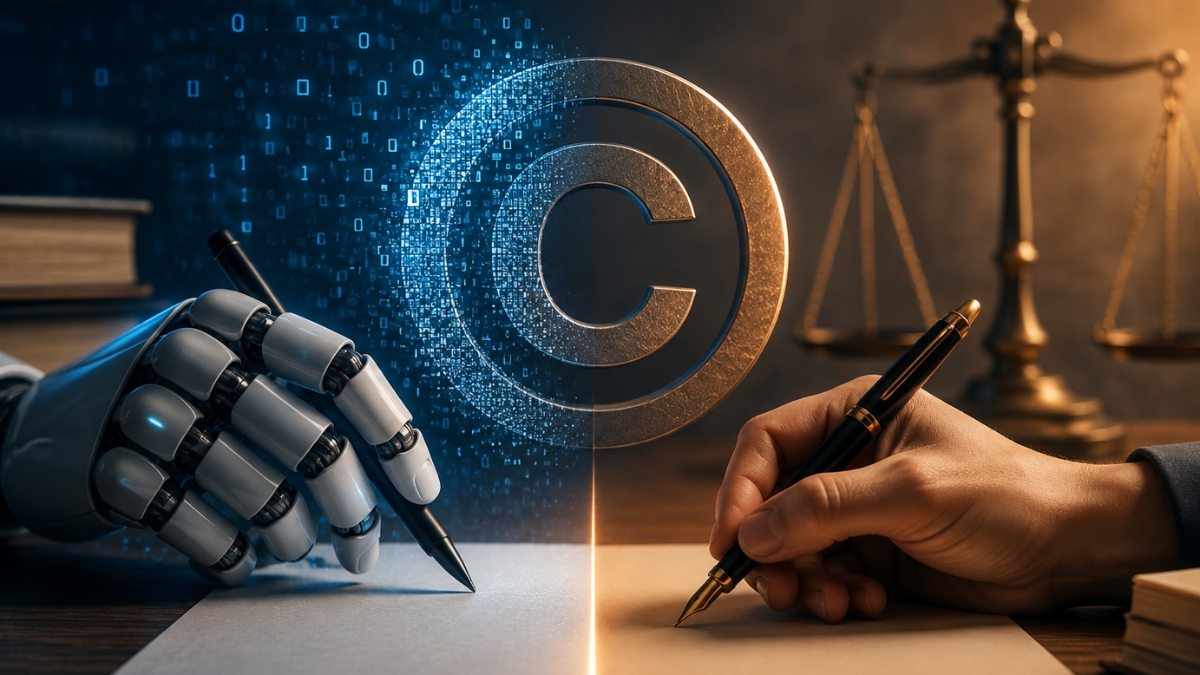
The growing use of artificial intelligence in creative work has created a difficult question for copyright law: when a machine generates the final work, who should legally be considered its author? India’s Copyright Office has now offered an important answer. In an order dated August 31, the office rejected an application seeking copyright registration for A Recent Entrance to Paradise, an artwork generated by an artificial intelligence system called DABUS. The decision does not dismiss AI-generated creativity altogether. Instead, it separates two questions that are often treated as one: whether a work is original and whether an AI system can legally be its author. That distinction could become increasingly relevant as creators use generative AI for images, videos, music, writing and other forms of content.
What was the DABUS case about?
The application was filed by American computer scientist Stephen L. Thaler. Thaler identified DABUS, short for Device for the Autonomous Bootstrapping of Unified Sentience, as the author of the artwork. He sought to be recorded as the copyright owner. His argument was based on the system’s autonomy. According to the application, DABUS generated the artwork after being trained using photographs, thesaurus entries and English sentences supplied by Thaler. The Copyright Office, however, had to determine whether that autonomy was enough to give the AI system legal authorship. It concluded that it was not.
Originality and authorship are different questions.
One of the more significant aspects of the order is that the Copyright Office did not simply classify the artwork as uncopyrightable because AI was involved. Instead, it found that the work could satisfy the originality requirement. The office noted that there was no evidence showing that the artwork reproduced a particular pre-existing work. It also considered its arrangement of colours, forms, tonal variations and spatial elements. This creates an important distinction.
An AI-generated work can potentially be original without the AI itself becoming its legal author.
The ruling therefore does not amount to a blanket statement that AI-assisted or AI-generated creative work cannot receive copyright protection. The more specific question is who can claim the legal authorship attached to that work.
Why the law points towards a human author
Section 2(d)(vi) of India’s Copyright Act deals with computer-generated artistic works. It identifies the author as the person who “causes the work to be created”. The dispute was therefore partly about how that phrase should be interpreted in an era where software can independently produce the final expression. The Copyright Office concluded that the relevant person is not necessarily the mechanism producing the final output. In this case, Thaler had developed and configured DABUS. He trained the system, supplied the inputs and initiated the process that eventually produced the artwork. The office therefore treated him as the legally relevant person behind the creation. Its reasoning can be broadly understood as distinguishing the creative mechanism from the legally responsible creator.
That distinction is already familiar in other forms of creative production. A camera can produce an image, for example, without becoming its author.
The question is whether AI changes that relationship enough to require a different legal framework. The Copyright Office said current Indian law does not support that conclusion.
AI does not currently have legal personality.
Another issue was DABUS’s legal status. The Copyright Office found that an AI system is not currently recognised under Indian law as either a natural person or a juristic person capable of holding legal rights.
That matters because copyright is not simply a label attached to a piece of content. Copyright creates a bundle of legal rights. Those rights can be owned, transferred, assigned and enforced. The Copyright Office therefore found that DABUS could not independently own copyright or transfer those rights to Thaler. This was another reason the application could not succeed in the form in which it was submitted.
Thaler was given another route.
The Copyright Office had previously given Thaler an opportunity to amend the application and identify himself as the author. He declined and continued to maintain that DABUS should be recognised as the author.
The application was subsequently rejected. The decision does, however, leave open the possibility of a fresh application identifying an appropriate legally recognised author. That is an important detail because it shows that the dispute was not simply about whether the artwork itself could ever receive copyright protection. It was also about who could legally occupy the position of author under the existing framework.
What does this mean for creators?
For creators increasingly using AI tools, the ruling could offer some clarity while leaving several practical questions unresolved. AI is already being used across the creative process. Creators may use it to generate concepts, write drafts, create images, modify footage or produce entirely new visual material. The Copyright Office’s reasoning suggests that the presence of AI does not automatically eliminate the possibility of copyright. But the degree of human involvement could become increasingly important. For instance, questions around who designed the process, supplied the creative inputs, selected outputs or exercised creative control could become relevant when determining authorship.
The order itself does not establish a detailed test for every possible form of AI-assisted creation. It instead applies the existing law to a case involving a system that was claimed to operate autonomously.
That distinction matters. Using AI as a creative tool and claiming that an autonomous AI system itself should own copyright are not necessarily the same legal proposition.
The bigger issue is still unresolved.
The most consequential part of the decision may ultimately be what it leaves open. The Copyright Office explicitly said that extending legal personhood or independent authorship to AI would be a policy question for Parliament. In other words, the office did not attempt to create a new category of legal author through administrative interpretation.
That leaves the broader question unresolved: if AI systems eventually become capable of substantially greater independent creative decision-making, should copyright law continue to treat them purely as tools? For now, India’s legal framework has not moved in that direction.
The DABUS ruling instead reinforces the existing structure. A work can be generated using sophisticated technology, but copyright authorship remains connected to a legally recognised person.
As generative AI becomes more deeply embedded in the creator economy, that distinction could become increasingly important, particularly when questions of ownership, licensing, attribution and commercial rights arise.
The ruling, therefore, may be less about stopping AI creativity and more about defining where legal responsibility sits when machines become part of the creative process.

‘I Couldn’t Express Myself Properly’: Aman Gandhi Opens Up About His Bigg Boss 20 Eviction

Bharti Singh and Haarsh Limbachiyaa to Launch Their Own Micro-Drama App

ShareChat and Moj Launch ‘Saas, Bahu aur Magic’ Micro-Drama With Glow & Lovely

Sanika Bhadane Gives Farah Khan’s ‘Dhoom Taana’ a Gen-Z Twist and the OG Loves It!

Who Are Priya Sharma and Sid Madiwale? The Indian-Australian Creators Who Joined MrBeast in Ghana

Hungry Mahi Teases New Business Venture After Winning Comedy Cooks

Mayuresh Gujar Hits 500K Followers After Six Years of Creating Content

Ishank Gupta, Sanya Rohillaa and Ahsan Vazir Win Big at Instagram’s Edits Film Festival

Prajakta Koli Becomes the Face of Rubans Accessories

“5 Years of Work Stolen”: Finance Influencer V Harish’s Final Video Before His Death

Food Pharmer’s Cannes Look That Never Walked

Parul Gulati Wears Nish Hair on the Cannes 2025 Red Carpet

Nancy Tyagi’s 700-Hour DIY Gown Turns Heads at Cannes 2025

Navya Nanda’s IIM Ahmedabad Triumph: From Controversy to Campus Joy

Influencer Kareema’s Heartwarming Journey with Suki

Prajakta Koli and Vrishank Khanal’s Wedding

Prajakta Koli’s Haldi and Cocktail Celebrations

Prajakta Koli and Vrishank Khanal’s Pre-Wedding Celebrations

Prajakta Koli x Vrishank Khanal Magical Mehendi

Milind Soman & Ankita’s Maha Kumbh 2025 Experience

YouTube Is Letting Creators See What Works for Their Competitors

YouTube Shorts Changes Repost Rules: What Creators Need To Know About Original Content

Adam Mosseri Reveals Instagram Trial Reels Rule That Could Limit Your Reach

What Is Meta’s New “Muse” AI And Why Are Users Seeing It?

Roopali Agrawal aka Rockonroops Turning Family Life Into Conversations On Fashion, Freedom And Safety

Eloelo Launches Dolphin AI: Will AI Video Tools Change The Future Of Creators And Filmmakers?

Is Orry Getting Married? Close Friends Story Sparks Questions As His Past Wedding Rumours Resurface

Why Is MrBeast Back in India? Is His India Connect Getting Bigger in 2026?

Creator Twinkle Dhoot Shares 10 Trial Reel Formats Creators Should Try
