
Tech
Ranveer Allahbadia Takes Gen Z Inside India’s Space-Tech Boom With Skyroot Visit
From ISRO-led reforms to private rockets, Skyroot shows how India’s space story is moving beyond government missions.

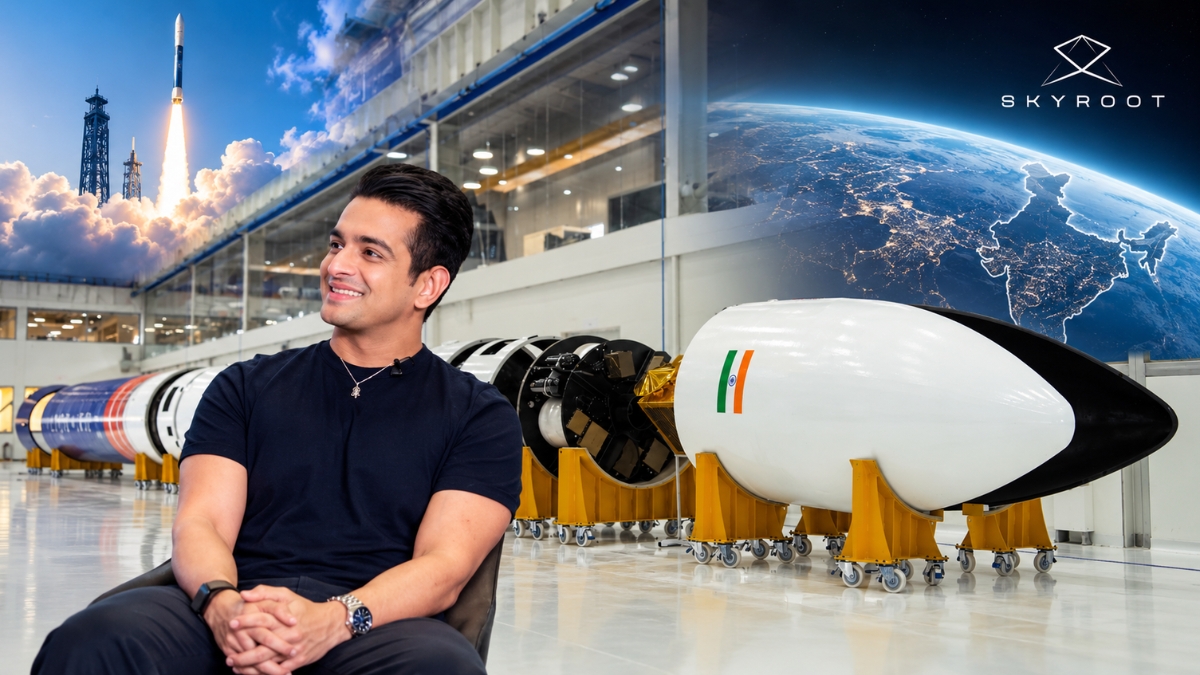
For most of us, “space technology” still sounds like something that belongs inside an ISRO control room. Rockets. Satellites. Scientists. Launch countdowns. But India’s space story is changing, and now some of the most interesting work is happening inside private companies. That is what makes Ranveer Allahbadia’s recent visit to Skyroot Aerospace interesting. The creator visited Skyroot’s facility in Hyderabad in September 2026 to meet co-founder and CEO Pawan Kumar Chandana for an upcoming episode of The Ranveer Show. He toured the facility, got a closer look at the company’s rockets and spoke about India’s private space sector. For a creator whose audience largely consists of young Indians, it is also a chance to make space technology feel less distant.
From ISRO to private space companies
India did not suddenly wake up to private space companies.
The government opened the space sector to private participation in 2020. It also created IN-SPACe, an independent agency designed to promote, enable, authorise and supervise private space activities.
The Indian Space Policy 2023 further established a framework for private companies to participate across the space economy, including launch vehicles, satellites and space-based services.
The idea was not to replace ISRO.
It was to let ISRO continue focusing on advanced research and national missions while private companies build, manufacture and commercialise technologies at scale. ISRO itself has described the reforms as an expansion of the space ecosystem rather than the privatisation of the organisation.
And Skyroot is one of the clearest examples of what that change has produced.
Skyroot went from startup to orbit
Founded in Hyderabad in 2018 by former ISRO scientists Pawan Kumar Chandana and Naga Bharath Daka, Skyroot began with an ambitious idea: make access to space more accessible.
In 2021, the company signed an agreement with the Department of Space that gave it access to ISRO facilities and expertise for developing and testing its launch-vehicle systems.
Then came Vikram-S.
In November 2022, Skyroot launched India’s first privately built rocket from Sriharikota. The suborbital mission tested technologies including propulsion, avionics and carbon-composite structures.
But the bigger milestone came in July 2026.
Skyroot’s Vikram-I became the first privately developed Indian orbital rocket to successfully reach orbit from Indian soil. The rocket carried payloads into Low Earth Orbit, marking a major step for India’s private space industry.
That is the story Ranveer is now taking to his audience.
Why should Gen Z care about rockets?
Because space technology is no longer only about astronauts.
Satellites support communication, navigation, weather monitoring, Earth observation and a growing range of services used on the ground.
Skyroot’s own business model is built around launching small satellites into orbit. Its Vikram-I is designed for dedicated and rideshare missions, with a payload capacity of up to 350 kg to Low Earth Orbit.
That connects space to industries young Indians already understand: connectivity, agriculture, climate monitoring, logistics, mapping, communications and data.
And there is another part that matters for the next generation of engineers.
This is becoming a career ecosystem, not just a science story.
Skyroot says it now has more than 1,000 experts and is hiring across engineering, avionics, composites, propulsion and other areas. It also runs a fellowship for young engineers and scientists to work on real space projects.
Why Ranveer’s visit matters
There is a difference between reading that India has a private space sector and actually seeing the people, rockets and facilities behind it.
That is where creators can play a useful role.
Ranveer is taking a subject that can feel highly technical and putting it into a format millions of young people already consume: a conversation, a tour and a story.
And Skyroot’s journey gives him a particularly strong story to tell.
An Indian startup that began in Hyderabad has developed rockets, worked alongside the country’s established space ecosystem and reached orbit.
Skyroot has also attracted international capital. The company says it has raised $160 million to date, at a valuation of $1.1 billion, from investors including GIC and Temasek.
So perhaps the bigger takeaway from Ranveer’s visit is not simply “a creator visited a rocket company.”
It is that India’s technology story is getting bigger than the names young Indians already know.
For Gen Z, technology in India is not only about apps, AI or smartphones.
It can also mean building the rocket that carries the next generation of satellites into space.
And when creators choose to take their audiences inside that world, they help make India’s space-tech story visible far beyond the industry itself.













MS Dhoni Becomes SpeakX Brand Ambassador For English Learning Campaign

Adam Mosseri Reveals Instagram Trial Reels Rule That Could Limit Your Reach

Ranveer Allahbadia Takes Gen Z Inside India’s Space-Tech Boom With Skyroot Visit

7 Indian States Using Creators To Promote Tourism, Culture And Government Schemes

Shru Gaming: The Mom Gamer Proving Gaming And Motherhood Can Coexist

RJ Naved Joins Radio City With ‘Prank You’

He Was In Krish And Koi… Mil Gaya. Now Dr. Mickey Dhamejani Is An Eye Doctor

From Product Experiments To A YouTube Award: Mohit Burad’s Six-Year Creator Journey

Amazon Best In Tech Awards 2026: Here Are The Winners Across Cameras, Wearables, Audio And More

Tarini Shah Gets A Call From Meta And Flies Across The World For A Major Event

Food Pharmer’s Cannes Look That Never Walked

Parul Gulati Wears Nish Hair on the Cannes 2025 Red Carpet

Nancy Tyagi’s 700-Hour DIY Gown Turns Heads at Cannes 2025

Navya Nanda’s IIM Ahmedabad Triumph: From Controversy to Campus Joy

Influencer Kareema’s Heartwarming Journey with Suki

Prajakta Koli and Vrishank Khanal’s Wedding

Prajakta Koli’s Haldi and Cocktail Celebrations

Prajakta Koli and Vrishank Khanal’s Pre-Wedding Celebrations

Prajakta Koli x Vrishank Khanal Magical Mehendi

Milind Soman & Ankita’s Maha Kumbh 2025 Experience

Meta One Launches With Paid AI, Creator Tools And New Features Across Instagram, Facebook And WhatsApp

Could Bilibili Be the Next Creator Opportunity for Indians?

AI Content Creator Platform Creedom Raises ₹4.1 Crore in Seed Funding

ScoutOP Reveals ₹30 Lakh Monthly Income

R Udhay Is Helping Creators Level Up Their Content With Editing, AI & Instagram Tips

Snoop Dogg Has the Job We All Secretly Want: ₹10 Lakh A Month to Eat Ice Cream

Internet Famous Golden Retriever Tucker Budzyn Diagnosed With Lymphoma

Delhi vs Mumbai Review: A Predictable Love Story That Somehow Works

Who Was Manjeet Kaur? What We Know About the Punjabi Influencer’s Death
