
Tech
India’s Internet Is 10 Times Faster Than In 2022. What Does That Mean For Everyday Life?
With 5G reaching every district and internet speeds rising sharply, India’s digital growth is changing how people work, create and connect.

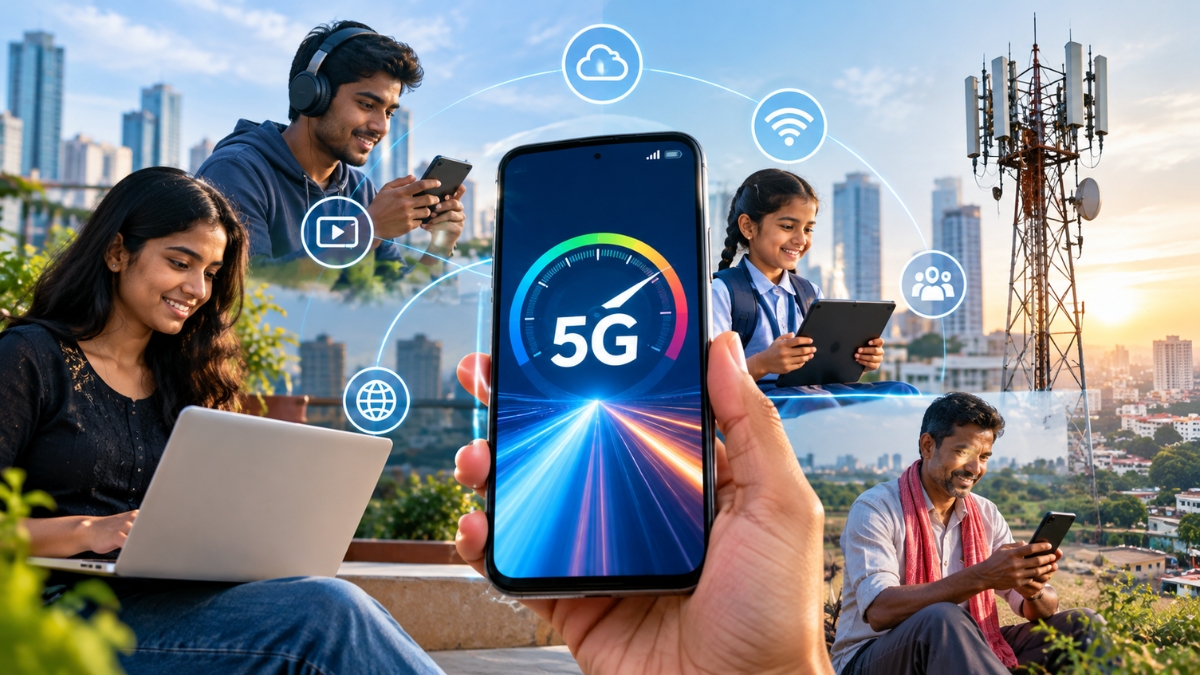
Think about the last time you tried to upload a video, download a large file or join a video call on a weak network. Now imagine doing the same task in a fraction of the time. That is the promise of India’s growing mobile internet infrastructure. Speaking at the 10th edition of the India Mobile Congress (IMC) on October 8, Prime Minister Narendra Modi said mobile internet speeds in India had increased ten-fold since the country launched 5G services in 2022. He also said 5G networks now operate through more than 5.5 lakh base stations, reaching every district in the country. The numbers point to a bigger change. India is not just getting faster internet. It is expanding the digital infrastructure that allows more people to access online services, build businesses and share content.
From 20 Minutes To Two: What Faster Internet Means
According to data cited by the Department of Telecommunications, average mobile broadband download speeds rose from 13.67 Mbps in March 2022 to 132 Mbps in December 2025.
That difference becomes easier to understand when you look at everyday downloads.
- A 1 GB file: Roughly 10 minutes at the 2022 average speed, compared with about one minute at 132 Mbps.
- A 2 GB movie: Around 20 minutes compared with roughly two minutes.
- A 5 GB file: About 49 minutes compared with around five minutes.
These are theoretical estimates, not guaranteed download times. Actual speeds depend on network coverage, congestion, signal strength, the server and the device.
Still, the improvement can make everyday digital tasks much quicker.
Large app updates can finish sooner. Cloud backups can take less time. Video calls can run more smoothly, while uploading high-resolution videos becomes easier when the connection is strong.
What This Means For Creators And Small Businesses
Faster mobile internet can also change how people earn, work and reach an audience.
For creators, uploading videos, backing up footage and managing content on the move can become easier. Someone filming a travel vlog in a smaller town, for instance, may be able to transfer footage or publish content without waiting until they return to a major city with a stronger connection.
For small businesses, better connectivity can support digital payments, online storefronts, customer communication and cloud-based tools. A local seller can reach customers beyond their neighbourhood, while a freelancer can work with clients in other cities or countries.
These benefits depend on reliable coverage, affordable data and access to suitable devices. Faster speeds alone cannot remove every digital barrier. But better infrastructure gives more people the chance to participate in India’s digital economy.
The Bigger Shift Is About Reach, Not Just Speed
A faster network matters, but so does where it works.
The expansion of 5G to every district, as cited by the Prime Minister, points to a wider push to extend mobile connectivity across the country. District-level availability does not mean every village, road or indoor location has strong 5G coverage. Local network quality can still vary.
Even so, broader coverage can help people access services that once required a trip to a city or a reliable fixed broadband connection. These include online learning, digital banking, telemedicine and government services.
It can also give creators and entrepreneurs more opportunities to work from different parts of India, rather than depending entirely on major urban centres.
India’s Technology Push Goes Beyond 5G
Connectivity is one part of the country’s wider technology shift.
Faster networks can support the use of cloud services, connected devices, real-time applications and emerging AI tools. They also help businesses move more work online and make digital services easier to access.
But network speed is only one measure of progress. Affordability, cybersecurity, data privacy, dependable coverage and digital skills will also shape how much people benefit.
India’s 5G expansion is therefore about more than downloading a movie in two minutes instead of 20. It is about building the infrastructure for people to learn, work, create and do business across a more connected country.
The next test is making sure that faster internet becomes a useful everyday reality for more people, wherever they live.

Eloelo Launches Dolphin AI: Will AI Video Tools Change The Future Of Creators And Filmmakers?

Surat Influencer Simran Patel Arrested Over Gandhi Reel: What We Know About Her Content

Why CRED Cast Rakhi Sawant To Explain Loan Stacking: Any Marketing Strategy?

Sufi Motiwala Turns 23, Celebrates Birthday After Recalling Near-Fatal Sea-Link Accident

OpenAI Releases 722 Maths Papers: Could AI Be Closing In On Longstanding Mathematical Mysteries?

India’s Internet Is 10 Times Faster Than In 2022. What Does That Mean For Everyday Life?

Creator-Actor Mahhi Vij’s Instagram Account Reportedly Disabled, Team Yet To React

Kavya Karnatac’s AI Wedding Prep Sparks Backlash Over Her AI Workshop Promotion

Mumbai’s ‘Flex-Free’ Plan: Can QR Codes Clean Up a Rs 4,000-Crore OOH Market?

Dhruv Rathee Joins Bengaluru Protest: Why The YouTuber’s Entry Has Put CJP’s Vote Row In Focus

Food Pharmer’s Cannes Look That Never Walked

Parul Gulati Wears Nish Hair on the Cannes 2025 Red Carpet

Nancy Tyagi’s 700-Hour DIY Gown Turns Heads at Cannes 2025

Navya Nanda’s IIM Ahmedabad Triumph: From Controversy to Campus Joy

Influencer Kareema’s Heartwarming Journey with Suki

Prajakta Koli and Vrishank Khanal’s Wedding

Prajakta Koli’s Haldi and Cocktail Celebrations

Prajakta Koli and Vrishank Khanal’s Pre-Wedding Celebrations

Prajakta Koli x Vrishank Khanal Magical Mehendi

Milind Soman & Ankita’s Maha Kumbh 2025 Experience

Meta One Launches With Paid AI, Creator Tools And New Features Across Instagram, Facebook And WhatsApp

YouTube Shorts Changes Repost Rules: What Creators Need To Know About Original Content

Adam Mosseri Reveals Instagram Trial Reels Rule That Could Limit Your Reach

Roopali Agrawal aka Rockonroops Turning Family Life Into Conversations On Fashion, Freedom And Safety

Technical Guruji’s iPhone 18 Pro Max Giveaway: Nearly 100 Phones And A Big Question About The Cost

Is Orry Getting Married? Close Friends Story Sparks Questions As His Past Wedding Rumours Resurface

What Is Meta’s New “Muse” AI And Why Are Users Seeing It?

The Traitors 2 Reunion Was Full Of Kalesh, Confrontations And Long-Pending Answers

Hardik Arora Teams Up With Meta for a Micro-Drama Series
