
News
Karnataka Wants AI To Talk, Listen And Help: ElevenLabs Deal Brings Voice AI To Public Services
From restoring lost voices to Kannada government services, Karnataka is exploring how voice AI could make technology more accessible.

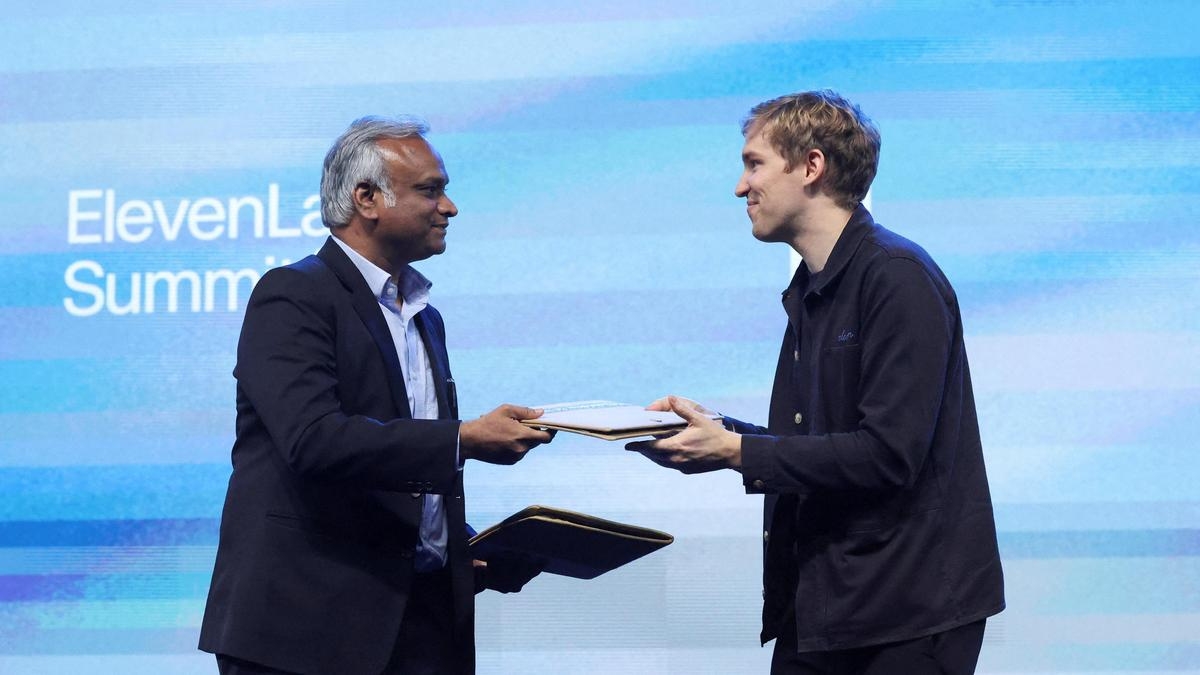
Imagine calling a government helpline in Kannada, explaining your problem naturally and getting help without navigating endless menus. These are some of the possibilities Karnataka is now exploring through a new partnership with ElevenLabs, the global voice AI company. The Karnataka Innovation and Technology Society (KITS), under the Department of Electronics, IT and Biotechnology, has signed an MoU with ElevenLabs to explore voice AI applications across citizen services, accessibility and public safety. The partnership goes beyond simply making AI voices sound realistic. It looks at how voice technology could become part of everyday public services, while also addressing the risks that come with increasingly convincing synthetic voices.
From AI Voices To Real-World Problems
The partnership will focus on three broad areas. The first is a Voice AI safety framework, aimed at addressing risks such as voice cloning, impersonation, deepfakes and voice fraud. The second is voice restoration. ElevenLabs says it has committed to restoring the voices of one million people who have permanently lost the ability to speak because of conditions including ALS, cerebral palsy, throat cancer and multiple sclerosis. The third area is the use of voice-based government services, including citizen helplines, grievance redressal and access to government information and entitlements in Kannada and other languages. That could make interacting with public systems easier for people who may not be comfortable navigating text-heavy digital platforms.
Giving People Their Voice Back
The accessibility aspect may be one of the most powerful parts of the partnership. ElevenLabs is offering free lifetime licences under its One Million Voices programme to eligible beneficiaries identified through the initiative. Karnataka is also working with the All India Institute of Speech and Hearing (AIISH), Mysuru, to identify people who could benefit from the technology. At the ElevenLabs Summit in Bengaluru, former radio and entertainment professional Sapna Rana, who lost her ability to speak after developing ALS, shared how recreating her voice allowed her to communicate and create again. For someone who has lost the ability to speak, a synthetic voice is not simply another AI feature. It can become a way to reconnect with everyday communication.
And Then There Is Kannada
The partnership also has a distinctly local angle. ElevenLabs says India is its second-largest market after the US, while businesses in the country recorded 100 million conversations using its ElevenAgents platform over the past year. More than 70% of those conversations were reportedly in Hindi, Kannada, Tamil and Telugu. The company also says more than 25,000 Indian developers and businesses are actively building with its API each month. Karnataka now wants to explore how that growing voice-AI ecosystem can translate into public services. That could mean government information being accessible through voice, citizen complaints being handled through conversational systems and services becoming easier to access in regional languages.
But Realistic Voices Come With Real Risks
The more convincing AI voices become, the more complicated the technology gets. A voice that sounds exactly like a real person can be useful for someone who has lost their ability to speak.
The same technology can also be misused to impersonate someone, create fraudulent calls or manufacture fake audio. That is why the Karnataka-ElevenLabs partnership will also examine safeguards around consent, watermarking, audio provenance, voice cloning and deepfakes. The challenge is no longer simply making AI sound human.
It is figuring out how to make sure people know when a voice is real, when it is synthetic and who has authorised it.
Why This Could Matter Beyond Government Offices
Voice AI is already becoming part of how people interact with technology.
People ask assistants questions, dictate messages, use voice searches and increasingly interact with AI through conversation rather than typing.
The next step could be using that same simplicity for essential services.
For someone who struggles with written interfaces, a voice system could be easier and to seeking information in Kannada, being able to speak naturally could remove a barrier. For someone filing a grievance, a conversational system could potentially make the process less intimidating. The technology still needs to prove that it can work reliably, safely and at scale. But that is what makes this partnership interesting.
Karnataka Is Testing What Comes After The Chatbot
AI has already moved from search boxes to chat windows.
Voice AI is taking it one step further. The Karnataka initiative is exploring a model where people could potentially speak to technology and get things done, rather than simply search for information. And at the same time, it is asking a question that will become increasingly important as synthetic media improves: If AI can recreate someone’s voice perfectly, how do we protect the person behind it? For Karnataka, the answer will have to involve both innovation and safeguards. Because the future of voice AI may not just be about making machines sound more human.
It could be about helping more humans be heard.

Mumbai’s ‘Flex-Free’ Plan: Can QR Codes Clean Up a Rs 4,000-Crore OOH Market?

Dhruv Rathee Joins Bengaluru Protest: Why The YouTuber’s Entry Has Put CJP’s Vote Row In Focus

Karnataka Wants AI To Talk, Listen And Help: ElevenLabs Deal Brings Voice AI To Public Services

What Is Meta’s New “Muse” AI And Why Are Users Seeing It?

Anurag Dobhal Arrested In Dehradun: What We Know About The Alleged Assault Case

Who Was Mad Sandhu? The Punjabi Creator Who Built A Beauty, Fashion And LGBTQ+ Voice Online

Ranveer Allahbadia’s Birthday Note For Juhi Bhatt Is Winning The Internet

Roopali Agrawal aka Rockonroops Turning Family Life Into Conversations On Fashion, Freedom And Safety

Navya Naveli Nanda Has A New Bet: Building India’s Next Big Tech Companies

Inside Idiotic Media’s BBD Playbook: How 1,600+ Creators Delivered 458M+ Views for Flipkart

Food Pharmer’s Cannes Look That Never Walked

Parul Gulati Wears Nish Hair on the Cannes 2025 Red Carpet

Nancy Tyagi’s 700-Hour DIY Gown Turns Heads at Cannes 2025

Navya Nanda’s IIM Ahmedabad Triumph: From Controversy to Campus Joy

Influencer Kareema’s Heartwarming Journey with Suki

Prajakta Koli and Vrishank Khanal’s Wedding

Prajakta Koli’s Haldi and Cocktail Celebrations

Prajakta Koli and Vrishank Khanal’s Pre-Wedding Celebrations

Prajakta Koli x Vrishank Khanal Magical Mehendi

Milind Soman & Ankita’s Maha Kumbh 2025 Experience

Meta One Launches With Paid AI, Creator Tools And New Features Across Instagram, Facebook And WhatsApp

YouTube Shorts Changes Repost Rules: What Creators Need To Know About Original Content

Adam Mosseri Reveals Instagram Trial Reels Rule That Could Limit Your Reach

Snoop Dogg Has the Job We All Secretly Want: ₹10 Lakh A Month to Eat Ice Cream

Technical Guruji’s iPhone 18 Pro Max Giveaway: Nearly 100 Phones And A Big Question About The Cost

Is Saurav Joshi Really Entering GTA VI? Here’s What We Found
Roopali Agrawal aka Rockonroops Turning Family Life Into Conversations On Fashion, Freedom And Safety

Is Orry Getting Married? Close Friends Story Sparks Questions As His Past Wedding Rumours Resurface

The Traitors 2 Reunion Was Full Of Kalesh, Confrontations And Long-Pending Answers
