
News
A YouTuber Begged For A Day And Earned ₹4000. Here’s What Happened
A Haridwar begging experiment claimed ₹4,000 in eight hours, sparking debate over donations, poverty and viral income claims.

What was the viral Haridwar begging experiment about?
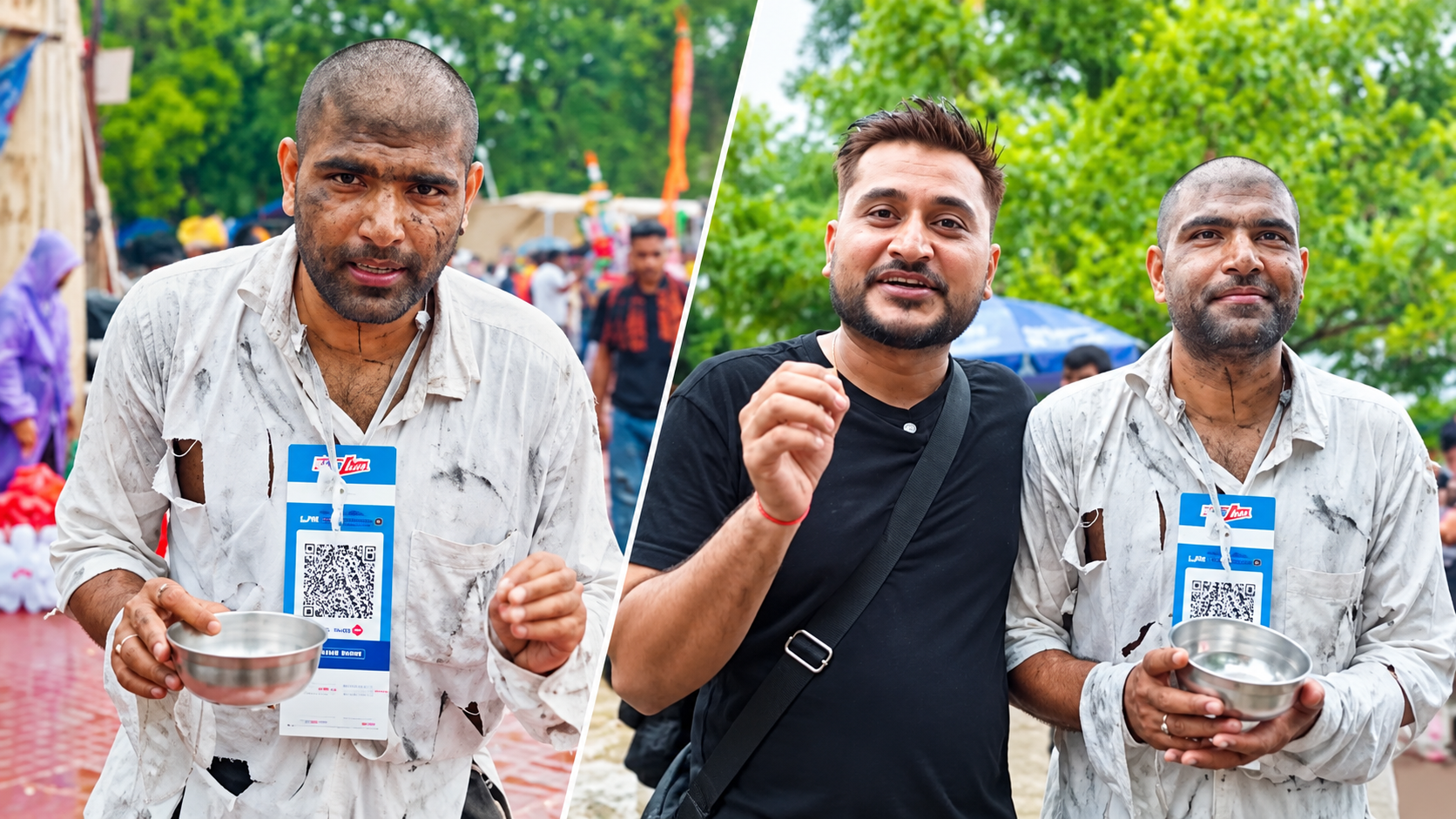
YouTuber Puroshottam Vashisht and his friend Sachin Yadav conducted a social experiment during the 2026 Haridwar Kanwar Mela to test how much money a person could collect by begging at a crowded religious gathering. Unlike some viral posts suggesting Vashisht himself went undercover, reports identify Sachin Yadav as the person who disguised himself as a beggar.
How did Sachin Yadav disguise himself?
Sachin reportedly wore old, torn clothes, smeared dirt on his face, carried a small bowl and approached devotees for money. The experiment also tested whether people would make digital donations, with a UPI QR code worn around his neck. The experiment continued for roughly eight hours.
How much money did he reportedly collect?
According to the creators, Sachin collected approximately ₹4,000 in eight hours, equivalent to an average of ₹500 per hour. However, this figure is a claim from the experiment, rather than an independently audited income figure. It should therefore not be treated as proof of typical earnings for people who beg.
Did he earn ₹4,000 consistently throughout the day?
No. The collection reportedly varied significantly. Sachin initially received only around ₹130, while his total after four hours was about ₹800. Much of the remaining amount came later. This shows why calculating a fixed hourly or daily income from the experiment can be misleading.
Did anyone donate through UPI?
Yes. The experiment reportedly received around ₹40 through digital payments via the QR code. The experimenters also said Sachin received food and water from some people. A sunglasses seller reportedly even gave him a pair of sunglasses.
Was begging as easy as the ₹4,000 figure suggests?
The creators reportedly concluded that it was not. Sachin had to approach strangers repeatedly, deal with rejection, walk around for hours and cope with difficult conditions, including rain. Guards also reportedly asked them to leave certain areas. The experimenters described the experience as physically and mentally exhausting.
Does ₹4,000 in eight hours mean beggars can earn ₹1.2 lakh a month?
Not necessarily. The creators reportedly calculated that earning ₹4,000 every day would amount to ₹1.2 lakh a month. But that is only a mathematical projection. The experiment took place during an unusually crowded religious gathering and lasted just one day.
What about claims of ₹2.5–₹3 lakh a month?
Those claims require even more caution. Some social-media users extrapolated the experiment’s hourly figure to suggest earnings of ₹8,000–₹10,000 per day. However, the experiment did not establish that such income is sustainable. Donations can fluctuate dramatically depending on location, crowds, timing, weather and individual circumstances.
Why has the experiment sparked debate?
The viral experiment has raised questions about donations at religious gatherings, UPI payments, begging as a livelihood and the ethics of poverty-related social experiments. Critics have also pointed out that a short experiment involving a disguised YouTuber cannot replicate the lived reality of people who depend on begging.
What is the biggest takeaway from the Haridwar experiment?
The most accurate conclusion is that one person reportedly collected around ₹4,000 during an eight-hour experiment at the 2026 Haridwar Kanwar Mela. It does not prove that genuine beggars earn ₹4,000 every day or ₹1.2–₹3 lakh every month. The viral number may be attention-grabbing, but the larger story is about how a single experiment can spark much bigger assumptions about poverty and income.












From Air Force Officer to Travel Creator: Amit Mehta’s Journey of Exploring India

Exclusive: YouTube Money Is Not Enough: Indrajit Lahiri on 10 Years of Foodka and Building a Business Beyond Content

Bhuvan Bam Explores Dubai’s Beautyworld Event as SARKAR Looks Beyond the Studio

Eloelo Launches Dolphin AI: Will AI Video Tools Change The Future Of Creators And Filmmakers?

Surat Influencer Simran Patel Arrested Over Gandhi Reel: What We Know About Her Content

Why CRED Cast Rakhi Sawant To Explain Loan Stacking: Any Marketing Strategy?

Sufi Motiwala Turns 23, Celebrates Birthday After Recalling Near-Fatal Sea-Link Accident

OpenAI Releases 722 Maths Papers: Could AI Be Closing In On Longstanding Mathematical Mysteries?

India’s Internet Is 10 Times Faster Than In 2022. What Does That Mean For Everyday Life?

Creator-Actor Mahhi Vij’s Instagram Account Reportedly Disabled, Team Yet To React

Food Pharmer’s Cannes Look That Never Walked

Parul Gulati Wears Nish Hair on the Cannes 2025 Red Carpet

Nancy Tyagi’s 700-Hour DIY Gown Turns Heads at Cannes 2025

Navya Nanda’s IIM Ahmedabad Triumph: From Controversy to Campus Joy

Influencer Kareema’s Heartwarming Journey with Suki

Prajakta Koli and Vrishank Khanal’s Wedding

Prajakta Koli’s Haldi and Cocktail Celebrations

Prajakta Koli and Vrishank Khanal’s Pre-Wedding Celebrations

Prajakta Koli x Vrishank Khanal Magical Mehendi

Milind Soman & Ankita’s Maha Kumbh 2025 Experience

Meta One Launches With Paid AI, Creator Tools And New Features Across Instagram, Facebook And WhatsApp

YouTube Shorts Changes Repost Rules: What Creators Need To Know About Original Content

Adam Mosseri Reveals Instagram Trial Reels Rule That Could Limit Your Reach

Roopali Agrawal aka Rockonroops Turning Family Life Into Conversations On Fashion, Freedom And Safety

What Is Meta’s New “Muse” AI And Why Are Users Seeing It?

Technical Guruji’s iPhone 18 Pro Max Giveaway: Nearly 100 Phones And A Big Question About The Cost

Is Orry Getting Married? Close Friends Story Sparks Questions As His Past Wedding Rumours Resurface

The Traitors 2 Reunion Was Full Of Kalesh, Confrontations And Long-Pending Answers

Why Is MrBeast Back in India? Is His India Connect Getting Bigger in 2026?
