
Entertainment
AI Influencers, Paid Loneliness and the Internet’s New Obsession: Are We Crossing a Dangerous Line?
As AI creators earn lakhs through subscriptions, the internet is questioning what people are truly paying for now.

Why Is the Rise of AI Influencers Becoming a Serious Internet Debate?
The internet has always rewarded attention. Viral creators, trending reels, aesthetic influencers and algorithm-friendly personalities have dominated social media for years now. But the latest rise of AI-generated influencers has pushed the conversation into far more uncomfortable territory.
Because this is no longer just about content. It is about emotional attachment, monetisation and how easily artificial personalities can now build paying audiences online.
What Is Happening on the Internet?
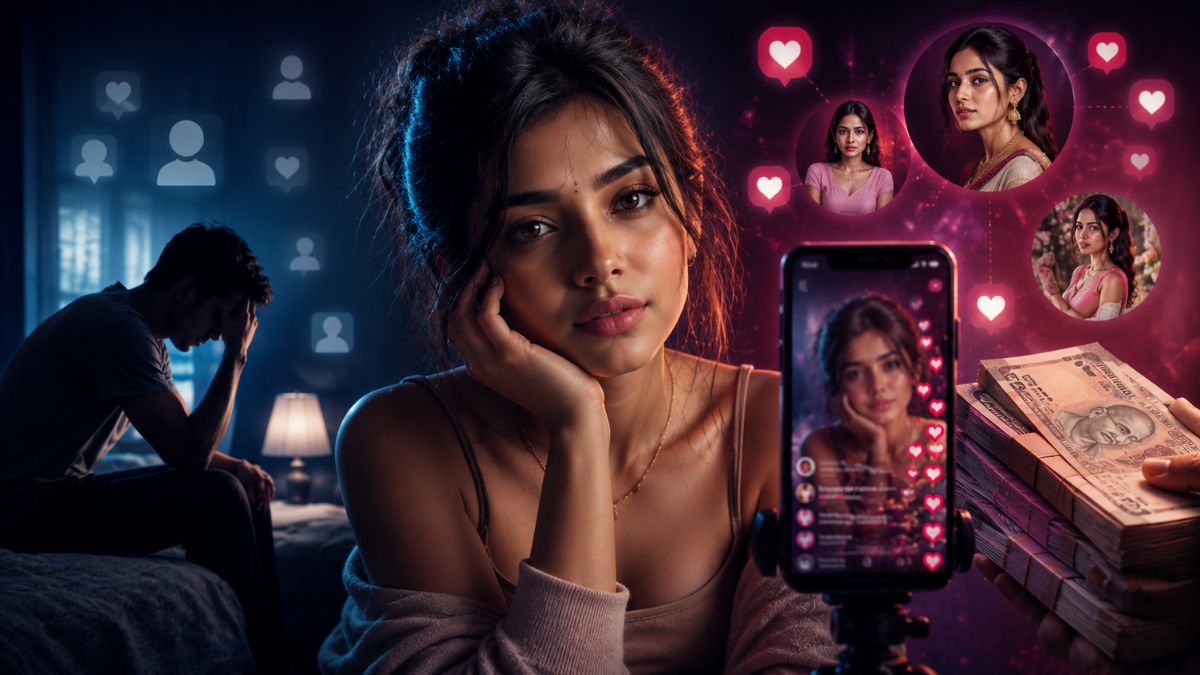
The recent viral attention around Vrutika Patel became one of the clearest examples of this shift. The AI-generated account reportedly crossed over 114,000 followers and gained more than 300 paid subscribers through Instagram subscriptions, potentially generating over Rs 1 lakh monthly.
And suddenly, people stopped debating whether the account was real.
The Reelstars began asking a more serious question: Why are people investing emotionally in accounts that do not even exist?
Also Read: The AI IPL Stadium Trend Taking Over Instagram
Who Is Vrutika Patel, and Why Did the Account Go Viral?
Vrutika Patel presents itself exactly like a modern lifestyle influencer account. The page posts reels, traditional Indian outfits, aesthetic visuals, IPL-related interactions, emotional captions, and “real-life” conversations with followers. At first glance, it behaves almost identically to hundreds of real creators online.
But the account is AI-generated. And yet, despite audiences openly suspecting or even knowing that possibility, the account still managed to attract subscriptions and significant engagement.
One reel even addressed the AI allegations directly, with the digital persona casually saying she uses AI to “enhance” content, almost normalising the blurred line between reality and artificial creation.
That moment captured exactly where the internet stands today:
People no longer seem shocked by AI personalities anymore.
They are adapting to them.
Is This Really About Technology or About Emotional Desperation?
That is where the debate becomes uncomfortable. Because the concern may not actually be AI itself. The bigger issue could be the emotional vacuum these accounts are filling online.
Many AI-driven influencer pages are designed to feel emotionally accessible. They simulate attraction, comfort, companionship, validation, fantasy and constant availability in ways real human interaction often cannot. Unlike real people, AI personalities never get tired, inconsistent, emotionally unavailable or complicated.
Everything becomes optimised for engagement. And in a digital culture already struggling with loneliness, parasocial attachment, and emotional isolation, these accounts enter a very vulnerable psychological space.
The worrying part is that monetisation now sits directly on top of that emotional dependency.
Why Are AI Subscription Models Making People Uneasy?
The conversation changes completely once money enters the picture.
Free entertainment is one thing. But when people begin paying monthly subscriptions for access to artificial personalities, the internet starts moving into ethically grey territory.
Because at that point, audiences are no longer casually consuming content. They are emotionally investing in digital illusions and this trend goes far beyond a single account.
Across social media platforms, there has been a visible rise in AI-generated personalities designed specifically around fantasy engagement. Some imitate influencers, some imitate companions, while others blur the line between emotional interaction and manipulation altogether.
What makes this even more alarming is how easy the process has become.
Today, someone can build a hyper-realistic online personality using AI-generated visuals, voice cloning, scripted captions and automated engagement tools within hours. For many, easy monetisation now feels only “one prompt away.”
Is AI Becoming the Fastest Shortcut to Online Money?
For some creators and operators, yes. The economics are extremely attractive. AI personalities do not need rest, privacy, emotional boundaries, or real-life maintenance. They can produce endless content, remain visually “perfect,” and adapt instantly to trends.
That scalability is exactly why the market around virtual influencers is growing rapidly worldwide.
And while many creators use AI responsibly for editing, scripting, or visual support, others are increasingly using it to build emotionally manipulative ecosystems designed entirely around engagement and monetisation.
That is the part that makes people uneasy.
Not because technology exists, but because emotional vulnerability itself is slowly becoming monetisable content.
Why This Debate Matters Beyond One Viral Account
The bigger concern is not whether AI influencers will continue growing.
They absolutely will. The real concern is whether audiences, platforms, and creators are prepared for the psychological and ethical consequences that come with it. Because social media has already trained people to seek emotional comfort online. AI simply removes the unpredictability of real humans from that experience. And perhaps that is why this conversation feels so important right now. Not because an AI creator is earning money. But because the internet may be entering a phase where attention, attraction, loneliness, fantasy, and monetisation are all collapsing into the same business model.

From Air Force Officer to Travel Creator: Amit Mehta’s Journey of Exploring India

Exclusive: YouTube Money Is Not Enough: Indrajit Lahiri on 10 Years of Foodka and Building a Business Beyond Content

Bhuvan Bam Explores Dubai’s Beautyworld Event as SARKAR Looks Beyond the Studio

Eloelo Launches Dolphin AI: Will AI Video Tools Change The Future Of Creators And Filmmakers?

Surat Influencer Simran Patel Arrested Over Gandhi Reel: What We Know About Her Content

Why CRED Cast Rakhi Sawant To Explain Loan Stacking: Any Marketing Strategy?

Sufi Motiwala Turns 23, Celebrates Birthday After Recalling Near-Fatal Sea-Link Accident

OpenAI Releases 722 Maths Papers: Could AI Be Closing In On Longstanding Mathematical Mysteries?

India’s Internet Is 10 Times Faster Than In 2022. What Does That Mean For Everyday Life?

Creator-Actor Mahhi Vij’s Instagram Account Reportedly Disabled, Team Yet To React

Food Pharmer’s Cannes Look That Never Walked

Parul Gulati Wears Nish Hair on the Cannes 2025 Red Carpet

Nancy Tyagi’s 700-Hour DIY Gown Turns Heads at Cannes 2025

Navya Nanda’s IIM Ahmedabad Triumph: From Controversy to Campus Joy

Influencer Kareema’s Heartwarming Journey with Suki

Prajakta Koli and Vrishank Khanal’s Wedding

Prajakta Koli’s Haldi and Cocktail Celebrations

Prajakta Koli and Vrishank Khanal’s Pre-Wedding Celebrations

Prajakta Koli x Vrishank Khanal Magical Mehendi

Milind Soman & Ankita’s Maha Kumbh 2025 Experience

Meta One Launches With Paid AI, Creator Tools And New Features Across Instagram, Facebook And WhatsApp

YouTube Shorts Changes Repost Rules: What Creators Need To Know About Original Content

Adam Mosseri Reveals Instagram Trial Reels Rule That Could Limit Your Reach

Roopali Agrawal aka Rockonroops Turning Family Life Into Conversations On Fashion, Freedom And Safety

What Is Meta’s New “Muse” AI And Why Are Users Seeing It?

Technical Guruji’s iPhone 18 Pro Max Giveaway: Nearly 100 Phones And A Big Question About The Cost

Is Orry Getting Married? Close Friends Story Sparks Questions As His Past Wedding Rumours Resurface

The Traitors 2 Reunion Was Full Of Kalesh, Confrontations And Long-Pending Answers

Why Is MrBeast Back in India? Is His India Connect Getting Bigger in 2026?
